
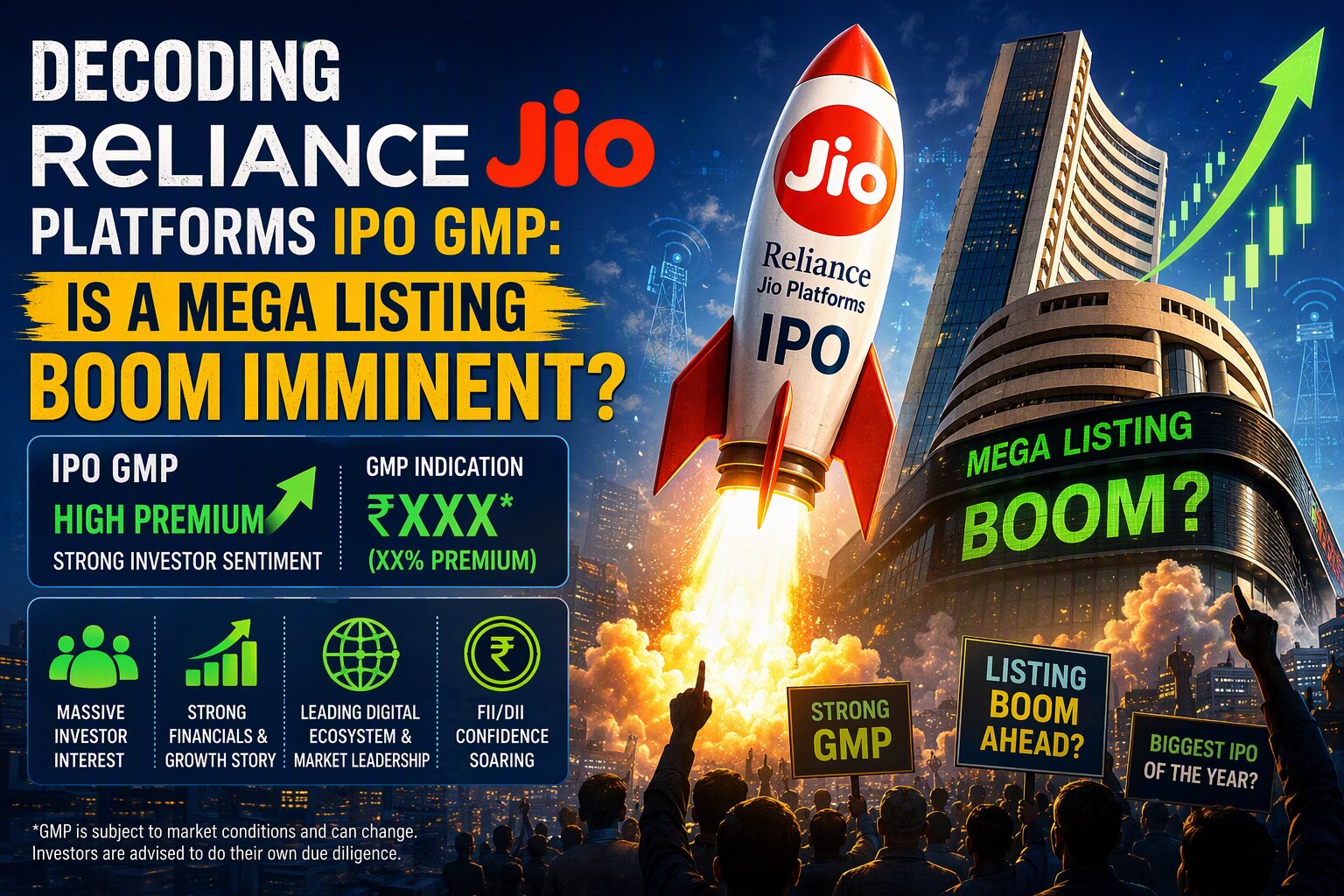
Every investor dreams of spotting the next massive wealth creator before it officially lists on the stock exchange. When Reliance Jio Platforms eventually goes public, millions will turn to the grey market for early signals. Tracking the Reliance Jio Platforms IPO GMP is currently the most reliable way to gauge market sentiment and anticipate potential listing gains. This premium reflects the price at which unofficial shares trade before the official listing day, offering a raw, unfiltered look at investor appetite.
Key Takeaways
- Market Sentiment: The GMP serves as a real-time pulse check of how institutional and high-net-worth investors value the Jio listing.
- Historical Context: Past Reliance IPOs provide a blueprint, though Jio’s digital dominance sets a new precedent.
- Volatility Risk: Unofficial premiums fluctuate wildly based on overall market conditions and regulatory changes.
- Investment Strategy: Relying solely on GMP is risky; fundamental valuation must anchor your final decision.
The Anticipation Behind Jio’s Market Debut
Reliance Jio has fundamentally rewired India’s digital ecosystem. Consequently, its anticipated public listing isn’t just another corporate event; it is a landmark moment for the entire Indian stock market. Investors are keenly aware of the wealth generated by previous Reliance ventures, and the Jio IPO is widely expected to dwarf those figures.
However, before the official prospectus is filed, the market relies on unofficial indicators. The Reliance Jio Platforms Ipo Gmp acts as a speculative compass. As a result, understanding what drives this premium is crucial for retail investors aiming to position their portfolios strategically.
Why This Mega-IPO Dominates Market Sentiment
Jio Platforms is not merely a telecom operator. It is a sprawling digital empire encompassing broadband, e-commerce, cloud infrastructure, and entertainment. This diversified revenue stream commands a higher valuation multiple compared to traditional telecom players. Furthermore, Reliance Industries Limited (RIL )’s backing provides an unparalleled safety net that few competitors can match.
As a result, the market is willing to pay a substantial premium in the grey market. The sheer scale of the offering means that even small fluctuations in the per-share premium can translate into massive absolute gains upon listing.
Exactly What Does Reliance Jio Platforms Ipo Gmp Mean for Investors?
To make informed decisions, look beyond surface-level numbers. The grey market premium is the price at which shares of an unlisted company are traded over-the-counter before the IPO lists on the exchange. For a highly anticipated issue like Jio, this premium can be volatile and highly informative.
Tracking the Reliance Jio Platforms IPO GMP means tracking supply and demand dynamics in the unlisted market. A rising premium signals strong demand and an expected pop on the listing day. Conversely, a declining premium indicates cooling enthusiasm, possibly due to broader market headwinds or concerns about the issue’s valuation.
Unpacking the Mechanics of the Grey Market
The grey market operates through a network of dealers who facilitate trades outside the formal exchange system. As a result, these transactions carry significant counterparty risk. Two primary metrics dominate this space: the Grey Market Premium (GMP) and the Kostak rate.
The GMP represents the price buyers are willing to pay over the IPO issue price. If the Jio IPO price is set at ₹300, and the GMP is ₹80, the share effectively trades at ₹380 in the grey market. The Kostak rate, by contrast, is a fixed compensation a seller receives for allotment, regardless of the listing price. Understanding these mechanics is vital when analyzing the premium data.
Historical Reliance IPOs and Market Precedents
Reliance has a storied history of public offerings, but not all have followed the same trajectory. The Reliance Power IPO in 2008, for instance, was met with massive hype but suffered a disastrous listing day, leaving investors with massive losses. Consequently, historical precedents serve as a vital cautionary tale.
On the other hand, Reliance Industries itself has been a stellar wealth compounder over the decades. More recently, anticipation around Reliance Retail’s IPO has drawn significant institutional interest. Therefore, evaluating the Reliance Jio Platforms Ipo Gmp requires acknowledging both the company’s stellar track record and the inherent risks of IPO investing.
Analyzing the Trajectory of Reliance Retail’s GMP
Before Jio’s filing, Reliance Retail’s anticipated listing provided a useful proxy. The retail arm’s grey market premium surged steadily as the listing date approached, reflecting strong institutional confidence. However, macroeconomic shocks caused sudden dips, demonstrating the fragility of grey market trends.
Investors should draw a direct line from these fluctuations to the underlying drivers. The grey market is highly sensitive to FII (Foreign Institutional Investor) flows and global liquidity. As a result, the Jio GMP will likely mirror these patterns, spiking during bullish phases and contracting during market corrections.
Key Factors That Will Dictate Jio’s Grey Market Premium
Several variables will shape the premium’s trajectory as the listing date approaches. First, the overall health of the Indian equity markets plays a pivotal role. A bullish Nifty 50 typically provides a strong tailwind for IPO premiums.
Second, the telecom sector’s regulatory environment is critical. Any adverse ruling by TRAI (Telecom Regulatory Authority of India) or unexpected spectrum pricing can severely dampen investor sentiment. Consequently, the Reliance Jio Platforms Ipo Gmp will likely react sharply to policy announcements.
How Global Liquidity Impacts Domestic IPO Sentiment
Global macro factors are impossible to ignore. When the US Federal Reserve raises interest rates, foreign investors typically pull capital out of emerging markets like India. This capital flight reduces the liquidity available for domestic IPOs, putting downward pressure on grey market premiums.
Conversely, a dovish stance from global central banks injects cheap money into the system, fueling risk-on sentiment. Therefore, tracking global interest rate trends is just as important as tracking the GMP itself when preparing for the Jio listing.
Evaluating Investment Strategies Before the Listing
A high GMP is not an automatic invitation to invest. You must balance the unofficial premium with the official valuation metrics outlined in the DRHP (Draft Red Herring Prospectus). Paying an excessive premium based solely on grey market hype can lead to disappointing listing-day results.
Instead, focus on the company’s Price-to-Earnings (P/E) ratio, debt-to-equity position, and future growth prospects. The Reliance Jio Platforms Ipo Gmp should merely act as a secondary confirmation of your fundamental thesis, not the primary driver.
How to Track the Grey Market Premium Safely
Because the grey market operates in a regulatory grey area, misinformation is rampant. Unscrupulous dealers often fabricate premium numbers to offload shares at inflated prices. Therefore, you must rely on aggregated data from multiple trusted financial sources rather than a single dealer’s claim.
Also, remember that grey market transactions are illegal and offer no investor protection. If a seller defaults on delivery, you have no legal recourse. Consequently, retail investors should avoid participating directly in the unlisted market and instead apply through the official IPO route.
Frequently Asked Questions
When is the Reliance Jio IPO expected to launch?
While Reliance Industries has not officially confirmed a launch date, market analysts widely anticipate the IPO between late 2025 and 2026. The timing depends heavily on securing favorable market conditions and regulatory approvals from SEBI and the telecom ministry.
How is the Reliance Jio Platforms IPO GMP calculated?
The GMP is calculated by taking the difference between the unofficial market price of the share and the official IPO issue price. For example, if the issue price is ₹300 and the grey market trading price is ₹350, the GMP is ₹50, representing a 16% premium.
Does a high GMP guarantee listing gains?
Absolutely not. While a high GMP generally signals strong demand, listing-day performance depends on broader market sentiment at the moment of listing. Sudden market crashes or negative news can instantly erase projected gains.
Where can I track the daily Jio IPO GMP updates?
You can track daily updates on dedicated IPO tracking websites, financial news portals, and specialized Telegram channels that aggregate dealer data. However, always cross-reference these figures with official announcements from Reliance Industries.
What is the difference between GMP and Kostak rates?
GMP is the premium over the issue price that buyers pay for shares in the grey market. The Kostak rate is a fixed fee paid to the seller to guarantee IPO allotment, regardless of whether the share lists at a profit or a loss on the stock exchange.