
Key Takeaways
- ✓ The DAX 40 tracks the 40 largest German companies listed on the Frankfurt Stock Exchange
- ✓ Unlike individual stocks, the DAX is a performance-weighted index, meaning dividend payouts are factored into its price
- ✓ Key drivers include the European Central Bank’s monetary policy, global trade sentiment, and the performance of Germany’s automotive sector
- ✓ Investors can gain exposure through ETFs, futures, options, and CFDs without buying individual shares
Have you ever wondered what truly moves the needle for one of Europe’s most powerful financial barometers? Understanding the mechanics behind the DAX index share price is essential for anyone looking to capitalize on Germany’s economic strength. Consequently, this comprehensive guide breaks down everything you need to know, from how the index works to actionable strategies for investing.
What Is the DAX Index?
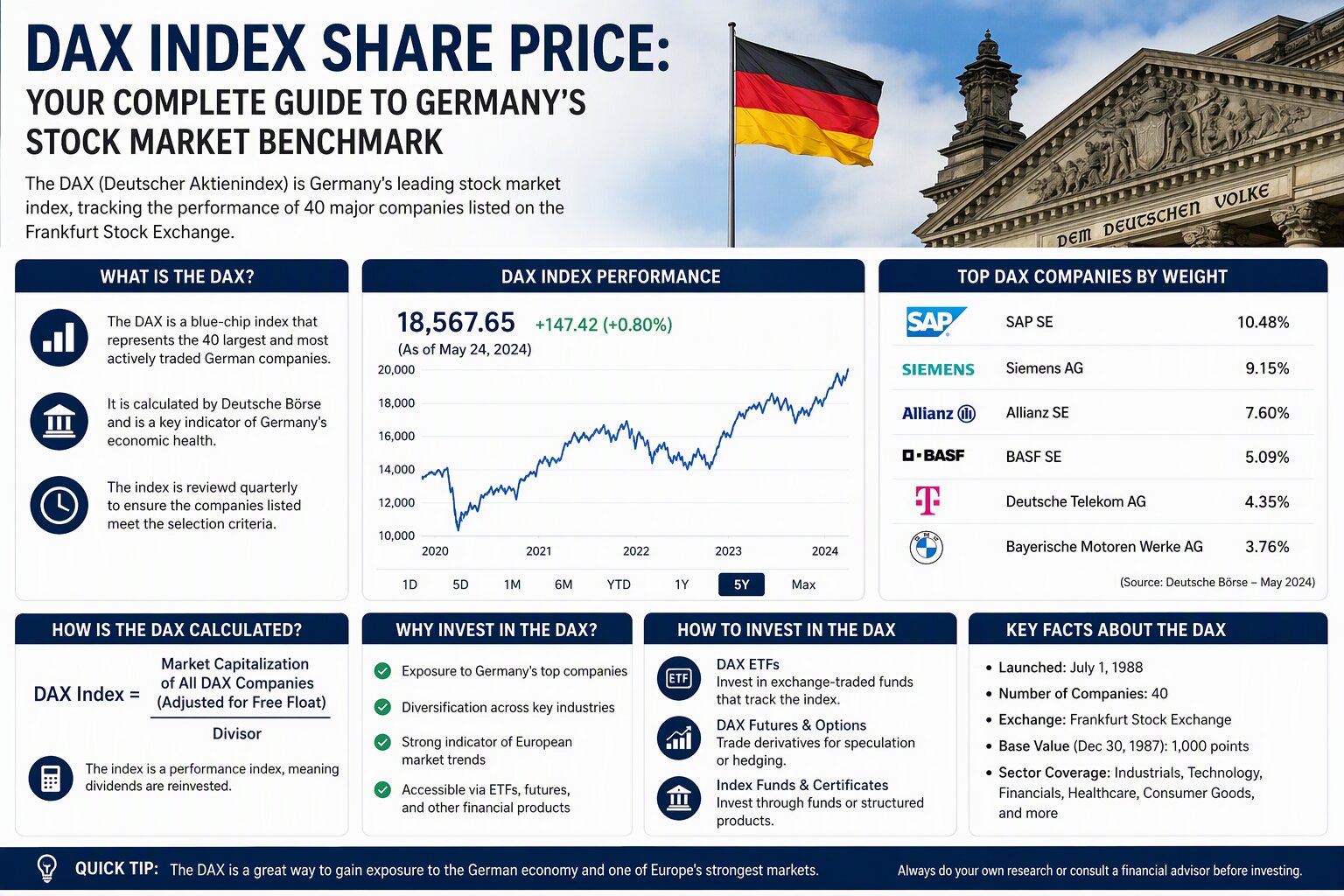
The Deutscher Aktienindex, commonly known as the DAX 40, represents the 40 largest and most actively traded German companies listed on the Frankfurt Stock Exchange. Furthermore, it serves as the primary benchmark for the German equity market, much like the S&P 500 does for the United States or the FTSE 100 does for the United Kingdom.
Originally launched in 1988 with a base value of 1,000 points, the index expanded from 30 to 40 constituents in November 2020 to broaden its diversification and reduce concentration risk. Moreover, the DAX is a performance index, meaning it includes reinvested dividends in its calculation, which gives a more complete picture of total returns compared to a price-weighted index.
Understanding How the DAX Index Share Price Is Calculated
The DAX uses a free-float market capitalization-weighted methodology. In other words, larger companies exert a proportionally greater influence on the index’s overall value. However, the calculation also factors in dividend distributions, making it a true total-return index.
Additionally, the weighting is capped to prevent any single stock from dominating the index. As a result, even if a company like SAP or Siemens grows massively, its influence on the overall index value remains balanced. This structure ensures the DAX remains a reliable barometer of the broader German economy rather than being skewed by one outlier performer.
Key Components of the DAX Calculation
- Free-Float Adjustment: Only shares available for public trading are counted, excluding locked-in holdings by governments or founding families
- Dividend Reinvestment: Corporate payouts are assumed to be reinvested back into the index, boosting the compound growth rate
- Market Cap Weighting: Companies with higher market capitalizations have a greater impact on daily index movements
- Xetra Trading Prices: The index values are derived from electronic trading on the Xetra platform, ensuring real-time accuracy
Key Factors Driving the DAX Price Movements
Several macroeconomic and sector-specific variables influence the trajectory of the DAX. Therefore, understanding these drivers helps investors anticipate potential market movements and position their portfolios accordingly.
European Central Bank Monetary Policy
Germany is the Eurozone’s largest economy, so ECB interest rate decisions directly affect borrowing costs for DAX-listed companies. Consequently, lower rates typically stimulate corporate investment and boost equity valuations, while rate hikes can compress multiples and reduce index performance.
Global Trade and Export Dynamics
German corporations are heavily export-oriented, with automobiles, machinery, and chemicals leading the charge. As a result, shifts in global trade tensions, supply chain disruptions, or currency fluctuations (particularly the EUR/USD exchange rate) have an outsized impact on the index’s constituents.
Automotive Sector Performance
Volkswagen, Mercedes-Benz, and BMW remain critical pillars of the DAX. Therefore, any significant developments in the automotive industry, such as the transition to electric vehicles, regulatory changes, or semiconductor shortages, can send ripples through the entire index. Furthermore, Porsche AG’s recent IPO added another heavyweight to the benchmark’s automotive representation.
The Current Market Landscape
As of early 2025, the DAX has demonstrated remarkable resilience despite facing headwinds from energy cost pressures and geopolitical uncertainty. However, the index’s valuation continues to attract international capital inflows due to Germany’s relatively attractive price-to-earnings ratios compared to US mega-cap tech stocks.
In addition, Germany’s “Zeitenwende” (turning point) in defense spending and infrastructure investment has opened new growth corridors for industrial and construction-related DAX constituents. Meanwhile, the global AI boom has propelled software giant SAP to record highs, underscoring how technology adoption is reshaping traditional German industrial powerhouses.
How to Invest in the DAX Index
You cannot directly buy shares of the DAX itself because it is an index, not a tradable asset. Nevertheless, multiple financial instruments provide direct exposure to its performance, catering to different risk profiles and investment horizons.
Exchange-Traded Funds (ETFs)
ETFs are the most accessible way for retail investors to track the DAX. Specifically, funds like the iShares DAX UCITS ETF (DE0005933931) or the Xtrackers DAX UCITS ETF offer low-cost, transparent exposure with intraday liquidity on major exchanges. Moreover, you can choose between distributing (pays dividends) and accumulating (reinvests dividends) share classes depending on your tax situation.
Futures and Options
For sophisticated traders, Eurex offers highly liquid futures and options contracts on the DAX. Consequently, these derivatives provide leverage and hedging capabilities that ETFs cannot match. However, they require margin accounts and carry amplified risk, making them suitable primarily for experienced market participants.
Contracts for Difference (CFDs)
CFDs allow traders to speculate on the DAX’s price direction without owning the underlying asset. Furthermore, they enable both long and short positions, making them popular for tactical trading strategies. Nevertheless, the high leverage embedded in CFDs demands rigorous risk management to avoid significant losses.
Top DAX-Listed Companies by Market Capitalization
The DAX features a diverse mix of blue-chip corporations spanning multiple industries. Here are some of the heaviest hitters that most influence the index’s daily movements:
- SAP SE: The enterprise software titan is the DAX’s largest constituent, with its cloud transformation driving substantial re-rating
- Siemens AG: An industrial conglomerate with deep exposure to automation, smart infrastructure, and healthcare technology
- Deutsche Telekom: Europe’s largest telecommunications provider, benefiting from stable cash flows and US market expansion via T-Mobile
- Allianz SE: A global insurance and asset management giant offering defensive characteristics to the index
- Volkswagen Group: The world’s largest automaker by revenue, currently navigating the EV transition
- Mercedes-Benz Group: A luxury automotive leader pivoting toward premium electric vehicles
DAX Trading Hours and Market Access
The DAX trades during standard Frankfurt Stock Exchange hours, which run from 9:00 AM to 5:30 PM Central European Time (CET). However, index futures trade nearly 24 hours a day on the Eurex platform, allowing global investors to react to overnight news and international market developments.
Additionally, US-based investors can access DAX-linked ETFs on European exchanges or through international brokerage accounts. Therefore, geographic location is no longer a significant barrier to participating in Germany’s equity market.
Strategic Considerations for Long-Term Investors
When building a long-term position tied to the DAX, diversification remains paramount. Specifically, combining DAX exposure with other European indices or global benchmarks reduces concentration risk. Furthermore, dollar-cost averaging into a DAX ETF during market dips can smooth out volatility and lower your average entry price over time.
Moreover, keeping an eye on the EUR/USD exchange rate is crucial for international investors. A strengthening euro erodes returns when repatriated to US dollars, while a weaker euro provides an additional tailwind. Therefore, currency-hedged ETF variants exist for those seeking to isolate pure equity performance from foreign exchange fluctuations.
Frequently Asked Questions
What time does the DAX index open and close?
The DAX officially trades from 9:00 AM to 5:30 PM CET on the Frankfurt Stock Exchange. However, index futures on Eurex begin trading much earlier, around 1:00 AM CET, providing near-24-hour market access for derivatives traders.
Is the DAX a price index or a performance index?
The DAX is a performance index, meaning it accounts for dividend distributions by assuming they are reinvested. This makes it different from a pure price index, which only tracks changes in share prices. Consequently, the DAX provides a more accurate reflection of total shareholder returns.
How many companies are in the DAX index?
The DAX currently comprises 40 companies. It was expanded from 30 to 40 constituents in November 2020 following the insolvency of Wirecard, which prompted reforms to improve diversification and governance standards within the index.
What is the highest the DAX has ever been?
The DAX reached its all-time high of approximately 22,612 points in late 2024, driven by strong earnings from SAP and easing inflation concerns. Historical peaks are continuously redefined as German corporates expand globally and the index benefits from compounding dividend reinvestment.
Can non-German residents invest in the DAX?
Yes, international investors can access the DAX through ETFs listed on European exchanges, futures on Eurex, or CFDs offered by global brokers. Additionally, many international brokerage platforms now support direct trading on the Frankfurt Stock Exchange, making German equities accessible worldwide.