
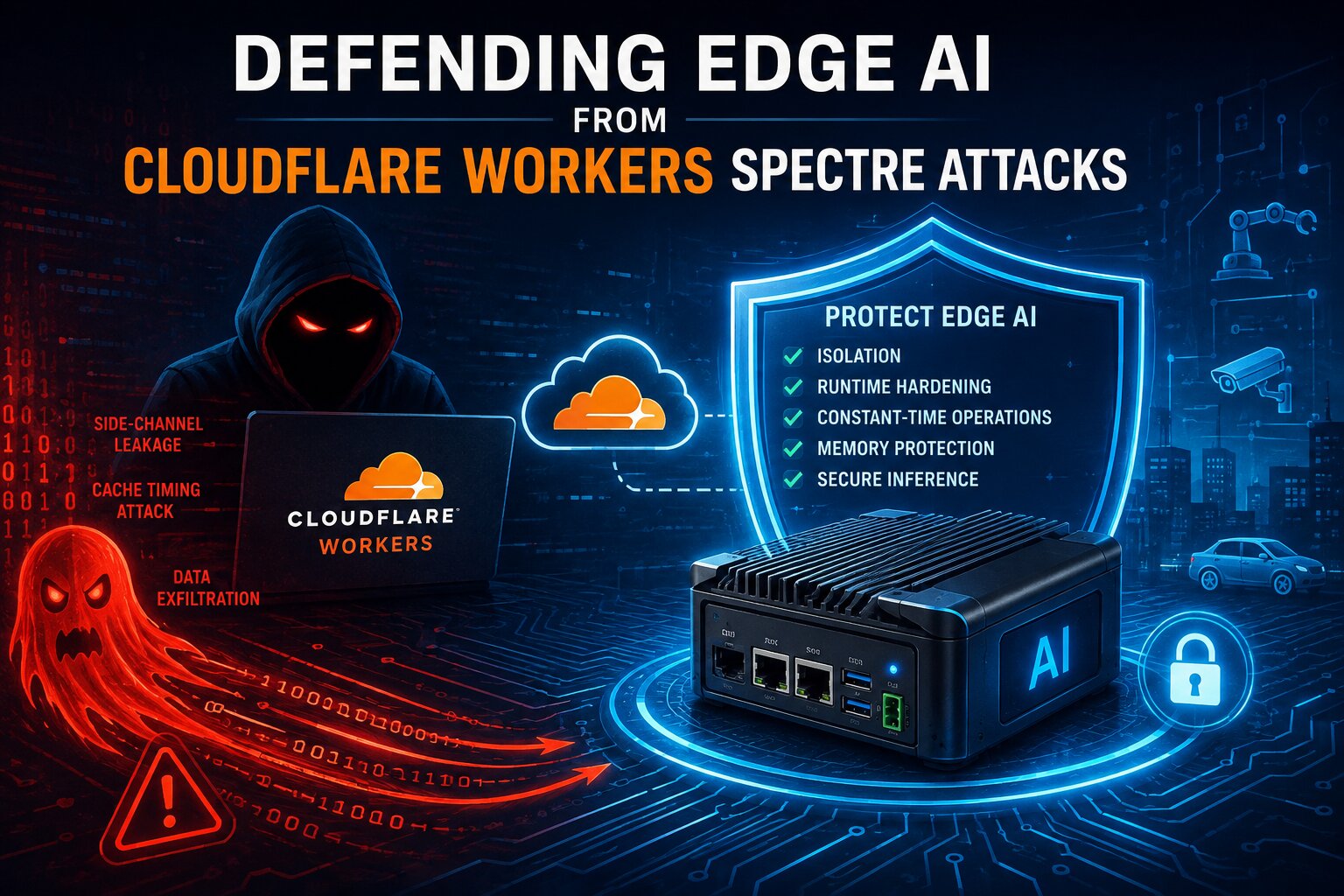
The Silent Threat at the Edge: Navigating the Cloudflare Workers Spectre Attack and the Future of AI Security
Estimated reading time: 7 minutes
- The Cloudflare Workers Spectre Attack highlights a side-channel vulnerability allowing sensitive data exfiltration from isolated edge environments.
- Speculative execution, a CPU performance enhancement, can be exploited to leak data like JWTs from co-located Workers.
- Even “slow” data leaks (12 bits/sec) pose significant business risks in the age of AI-driven automation and hyper-automation.
- Businesses must adopt Zero Trust architectures, prioritize end-to-end encryption, diversify their tech stack, and monitor for anomalous patterns.
Table of Contents:
- Understanding the Implications of the Cloudflare Workers Spectre Attack
- Why “Slow” Data Leaks Are a Major Business Risk
- The Intersection of Edge Computing, AI, and Security
- Building a Resilient AI-Driven Enterprise: Practical Takeaways
- How AI TechScope Secures the Future of Automation
Understanding the Implications of the Cloudflare Workers Spectre Attack
In the rapidly evolving landscape of decentralized computing and edge intelligence, security is no longer a secondary consideration—it is the very foundation upon which digital transformation is built. As businesses increasingly migrate their logic, data processing, and AI-driven workflows to serverless environments to achieve lightning-fast latency, a new frontier of vulnerability has emerged. Recent reports regarding the Cloudflare Workers Spectre Attack have sent ripples through the cybersecurity community, highlighting a sophisticated method by which sensitive data can be exfiltrated from supposedly isolated environments. For tech-forward leaders and entrepreneurs, understanding this development is not just about grasping a technical glitch; it is about understanding the inherent risks of the modern, automated, and distributed cloud infrastructure that powers today’s AI revolution.
At its core, the recent discovery involving the Cloudflare Workers Spectre Attack centers on a “side-channel” vulnerability. To understand why this is significant, we must first understand the architecture of the modern web. Cloudflare Workers, like many “serverless” computing platforms, allows developers to run code in small, isolated containers (often called “Workers”) distributed globally across the “edge”—the points of presence closest to the end-user. This architecture is what allows an AI chatbot to respond instantly or an automated n8n workflow to trigger a business process without the delay of communicating with a centralized server halfway across the world.
The vulnerability exploits a phenhttps://www.example.com/ai-chatbotsomenon known as “speculative execution,” a performance-enhancing technique used by modern CPUs. To speed up processing, a CPU “guesses” which path a piece of code will take and begins executing those instructions in advance. If the guess is wrong, the CPU discards the work, but the “ghost” of that computation remains in the CPU’s cache. Researchers discovered that by carefully measuring the time it takes to access certain data, an attacker co-located on the same physical hardware could essentially “see” the traces of data belonging to another Worker.
In this specific instance, researchers were able to leak JSON Web Tokens (JWTs) from a co-located Worker at a rate of up to 12 bits per second. While 12 bits per second may sound incredibly slow—almost negligible to the uninitiated—in the world of cryptography, any successful leak of information is a critical breach. A JWT is a digital “passport” used to authenticate users and authorize access to APIs. If an attacker can slowly reconstruct these tokens, they can potentially impersonate users, hijack sessions, and gain unauthorized access to sensitive business data or proprietary AI models.
Why “Slow” Data Leaks Are a Major Business Risk
One might ask: *If the leak is only 12 bits per second, why should I be concerned?*
For a business professional, the answer lies in the nature of automated attacks and the value of the data being targeted. An attacker does not need to steal an entire database in a single millisecond. In a coordinated, *low-and-slow* attack, an adversary can remain undetected for weeks or months, incrementally gathering enough pieces of a puzzle to compromise a high-value target. In an era where AI agents are being granted “keys to the kingdom”—access to your CRM, your financial tools, and your customer databases via API integrations—a stolen JWT is the equivalent of a master key.
This discovery underscores a vital reality: as we move toward a world of hyper-automation, the security of the underlying infrastructure becomes a direct component of your business’s operational risk.
The Intersection of Edge Computing, AI, and Security
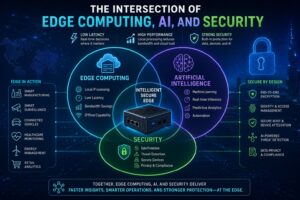
The emergence of the Cloudflare Workers Spectre Attack is particularly relevant to the current boom in “Edge AI.” To make AI tools truly useful, they need to be embedded directly into user workflows. This requires running machine learning inference and complex logic as close to the user as possible. Whether it is an AI-powered customer service bot, a real-time translation service, or an automated content moderation tool, these applications often rely on the very serverless technologies that this vulnerability targets.
When you deploy an AI automation via a platform like n8n, you are often orchestrating a series of calls to various APIs. Some of these calls may happen at the edge to ensure speed. If the environment where those API keys or user tokens are being processed is vulnerable to side-channel attacks, the entire automation pipeline is at risk.
This creates a paradox for the modern enterprise: the technologies that drive efficiency and scale (Edge Computing and AI) also expand the attack surface. As we lean harder into digital transformation, the complexity of our “tech stack” increases, and with that complexity comes a higher degree of interdependence. A vulnerability at the hardware level (the CPU) can manifest as a catastrophic data breach at the application level (the AI agent).
Building a Resilient AI-Driven Enterprise: Practical Takeaways
While the news of a Spectre-style attack can be unsettling, it should be viewed as a catalyst for maturing your digital strategy. Security should not be a reactive measure; it must be an architectural principle. Here are several practical takeaways for business leaders and entrepreneurs:
1. Adopt a “Zero Trust” Architecture
Never assume that because a process is running within a “secure” cloud environment, it is inherently safe. Implement Zero Trust principles across your automation workflows. This means every request, every API call, and every data movement must be verified, regardless of where it originates. If you are using AI to automate tasks, ensure that the credentials used by those agents have the “least privilege” necessary to complete the task.
2. Prioritize End-to-End Encryption and Token Management
Since the vulnerability specifically targeted JWTs, it is imperative to review how your business handles authentication. Use short-lived tokens whenever possible to minimize the window of opportunity for an attacker. Furthermore, ensure that sensitive data is encrypted not just at rest, but in transit and, where possible, in use.
3. Diversify and Audit Your Automation Stack
Relying on a single provider or a single layer of technology creates a single point of failure. When building complex workflows using tools like n8n, ensure you have visibility into every step of the data journey. Regular security audits of your automation logic—not just your code, but the *flow* of information—are essential to identify potential leak points.
4. Monitor for Anomalous Patterns
In the case of the Cloudflare discovery, the attack was extremely slow. Traditional security monitoring might miss a “low-and-slow” exfiltration attempt. Investing in AI-driven security monitoring that can detect subtle anomalies in data access patterns is becoming a necessity for any company handling sensitive client information.
How AI TechScope Secures the Future of Automation
At AI TechScope, we understand that the excitement of AI-driven growth must be balanced with the discipline of robust, secure implementation. As a leader in AI-powered automation and business process optimization, we don’t just build workflows that work; we build workflows that are resilient.
The Cloudflare Workers Spectre Attack highlights the importance of high-level architectural oversight. This is exactly where our expertise becomes your competitive advantage.
Intelligent n8n Workflow Development
We specialize in creating sophisticated automation pipelines using n8n, the industry standard for workflow orchestration. When we design an automation for your business, we don’t just focus on the “happy path” where everything goes right. We architect for the “exception path.” This includes implementing secure credential management, error handling, and data validation within every node of your workflow. By compartmentalizing tasks within n8n, we ensure that even if one part of a process is compromised, the “blast radius” is contained, preventing a total system breach.
Expert AI Consulting and Digital Transformation
Navigating the transition from manual processes to AI-driven automation is a daunting task. Our consulting services are designed to guide tech-forward leaders through this journey. We help you assess your current infrastructure, identify the best tools for your specific needs (balancing speed, cost, and security), and implement a roadmap for digital transformation that is both ambitious and secure. We look at your business holistically, ensuring that your move toward AI is supported by a foundation of best practices in cybersecurity and data integrity.
Secure Website Development and Integration
A company’s website is often the primary interface for its customers and the entry point for its data. Our web development services ensure that your digital storefront is not only high-performing and aesthetically pleasing but also built on secure, modern frameworks. We integrate AI capabilities directly into your web presence in a way that maintains user privacy and protects against the evolving landscape of web-based vulnerabilities.
Conclusion: Turning Vulnerability into Strength
The discovery of the Cloudflare Workers Spectre Attack is a reminder that in the digital age, the ground beneath our feet is constantly shifting. As hardware vulnerabilities emerge and new methods of exploitation are found, the businesses that thrive will be those that view security as a dynamic, ongoing process rather than a static checkbox.
The shift toward edge computing and AI automation is inevitable. It is the key to unlocking unprecedented levels of efficiency, scalability, and customer engagement. By understanding the risks, adopting a proactive security posture, and partnering with experts who understand the intersection of AI and infrastructure, you can turn these technological shifts into a powerful engine for growth.
Is your business ready to scale securely?
Don’t let the complexities of the evolving tech landscape slow your momentum. Whether you are looking to automate your manual operations, integrate cutting-edge AI into your existing workflows, or undergo a complete digital transformation, AI TechScope is here to lead the way.
Frequently Asked Questions
What is a side-channel vulnerability?
A side-channel vulnerability is a security exploit that doesn’t target a weakness in the logic of a program itself, but rather in its physical implementation. This can include timing differences, power consumption, or electromagnetic radiation. In the case of the Cloudflare Workers Spectre Attack, the timing of CPU cache access was exploited.
How does speculative execution contribute to security risks?
Speculative execution is a performance optimization where a CPU guesses the outcome of an operation and executes instructions in advance. While it speeds up processing, the intermediate data states left in the CPU’s cache can be observed by an attacker on the same hardware, creating a “ghost” of the computation that can be used to infer sensitive information.
Why are JWTs important, and what are the risks if they are leaked?
JSON Web Tokens (JWTs) are commonly used for securely transmitting information between parties as a JSON object. They are often used for authentication and authorization. If an attacker can obtain a JWT, they can potentially impersonate the user associated with that token, gain unauthorized access to resources, and compromise sessions.
What is “Edge AI” and why is it relevant to this attack?
Edge AI refers to the implementation of artificial intelligence algorithms directly on edge devices or at the network edge, closer to the data source. This allows for faster processing and reduced latency, which is crucial for real-time applications. Serverless platforms like Cloudflare Workers are often used to deploy Edge AI, making them a potential target for attacks that exploit the underlying infrastructure.
How can businesses protect themselves from similar vulnerabilities?
Businesses should adopt a multi-layered security approach. This includes implementing Zero Trust architectures, prioritizing strong end-to-end encryption, carefully managing and rotating authentication tokens, diversifying their technology stack to avoid single points of failure, and investing in advanced security monitoring solutions that can detect subtle anomalous behavior.