
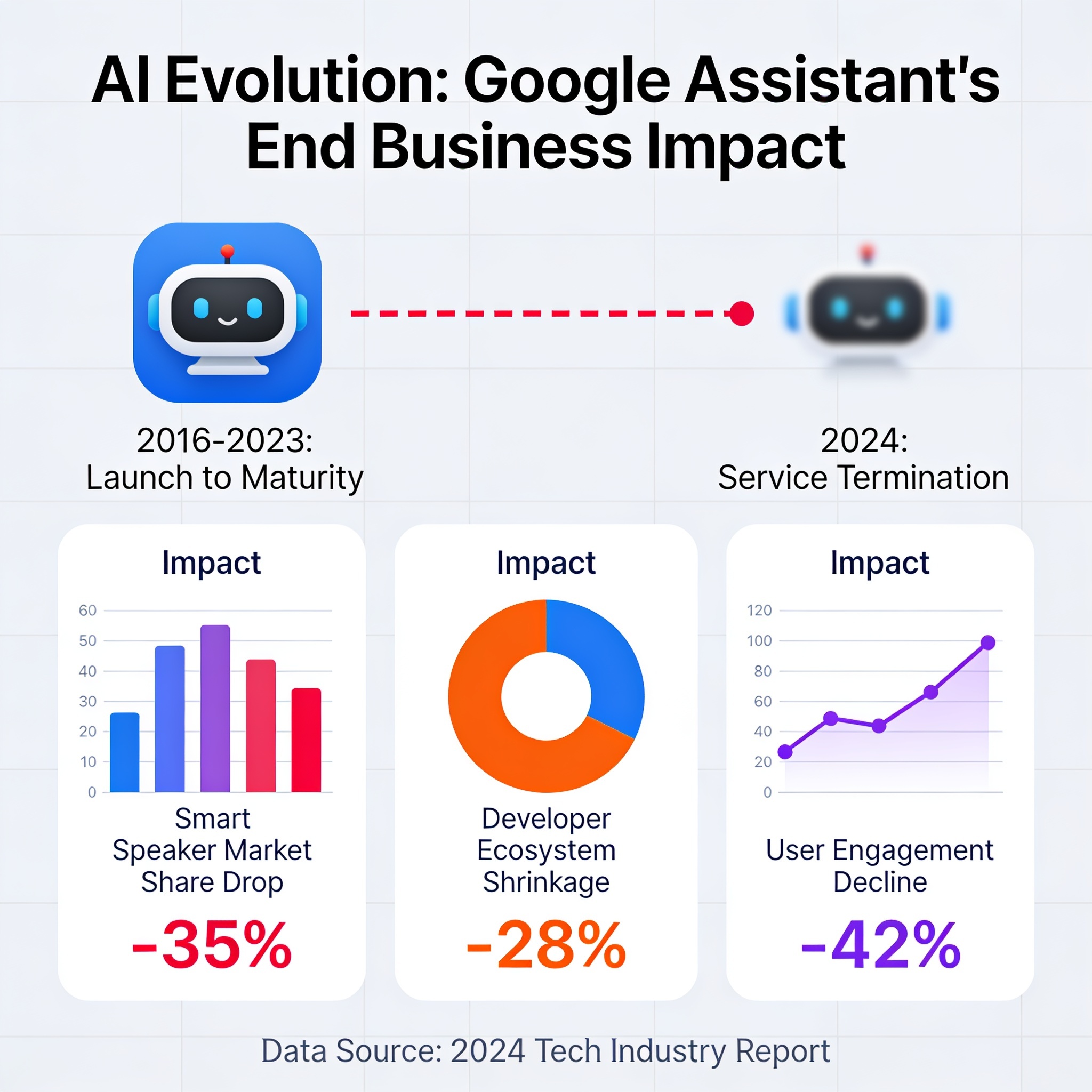
The End of an Era: What Google Assistant’s Disappearance Means for the Future of AI and Your Business
Estimated reading time: 10 minutes
Key Takeaways
- Google Assistant is being phased out starting September 4th on Android devices, signaling a major shift from rule-based AI to more advanced, generative, and context-aware models.
- The transition is driven by the rise of Gemini, Google’s next-generation, multi-modal generative AI, which offers superior reasoning, understanding, and content creation capabilities compared to its predecessor.
- Businesses must move beyond reactive, task-specific AI to embrace proactive, generative AI for enhanced customer experience, operational efficiency, and competitive advantage.
- This evolution demands a re-evaluation of current AI strategies, focusing on seamless integration, data security, ethical AI, and investing in AI literacy for teams.
- Partnerships with AI specialists, like AITechScope, are crucial for navigating this complex landscape, leveraging tools like n8n automation for integrated, intelligent workflows and strategic AI adoption.
Table of Contents
- The End of an Era: Why Google Assistant is Stepping Aside
- Beyond the Assistant: The Dawn of Generative AI
- What This Means for Business Leaders
- Navigating the New AI Landscape: Practical Steps for Your Business
- Leveraging AI Automation for Tomorrow’s Success with AITechScope
- The Future is Automated, Intelligent, and Integrated
- Frequently Asked Questions (FAQ)
The world of artificial intelligence is in a constant state of flux, evolving at a pace that can feel dizzying even for seasoned tech professionals. Breakthroughs that once seemed like science fiction are now becoming everyday realities, transforming how we interact with technology, conduct business, and manage our daily lives. This relentless march of progress occasionally necessitates a farewell to beloved, albeit older, technologies to make way for the new. This month, we witness one such pivotal transition as Google Assistant, a ubiquitous presence in millions of devices worldwide, prepares to exit the stage.
Starting September 4th, Google will begin removing access to Google Assistant on Android phones, tablets, smartwatches, and headphones. This isn’t just a simple product update; it’s a clear signal from one of the tech giants about the direction of AI, marking a significant shift from rule-based, command-and-control AI to more sophisticated, generative, and context-aware models. For business professionals, entrepreneurs, and tech-forward leaders, understanding the implications of this transition is crucial for navigating the evolving digital landscape and strategically positioning your organization for future success. This development isn’t merely about a voice assistant disappearing; it’s a profound indicator of a new era of AI that demands a re-evaluation of how businesses leverage intelligent automation and virtual assistant services.
The End of an Era: Why Google Assistant is Stepping Aside
For years, Google Assistant has been a cornerstone of Google’s AI strategy, providing hands-free control, quick information retrieval, and smart home management for users globally. From setting alarms to answering trivia questions, its convenience was undeniable. However, the announcement, reported by publications like The Verge, confirms that its days are now numbered. Google’s decision to sunset Google Assistant on mobile and paired devices by early September stems directly from the rapid ascendancy of its next-generation AI, Gemini.
This move underscores a fundamental shift in AI development. Google Assistant, while powerful for its time, operated largely within predefined parameters and scripts. It was excellent at executing specific commands and fetching factual information, but its ability to understand complex context, engage in nuanced conversations, or generate creative content was inherently limited. It represented the peak of what we might call “reactive AI” – systems designed to respond to explicit user input with pre-programmed actions or information.
The arrival of Gemini, Google’s most capable and general-purpose AI model, has rendered the older architecture of Google Assistant increasingly redundant. Gemini represents a leap towards “proactive” and “generative AI,” capable of much more sophisticated reasoning, understanding, and creation across various modalities – text, code, images, audio, and video. This isn’t just an upgrade; it’s a paradigm shift from a useful tool to a collaborative intelligent agent. For businesses, this transition signals an urgent need to re-evaluate their current AI adoption strategies and explore how advanced generative AI can transform operations, customer engagement, and product development.
Beyond the Assistant: The Dawn of Generative AI
The move from Google Assistant to Gemini is emblematic of a broader industry-wide transition towards generative AI models. To truly grasp the significance for your business, it’s essential to understand the core differences:
- Rule-Based vs. Generative: Traditional assistants like the original Google Assistant largely relied on extensive rule sets and natural language processing (NLP) to interpret commands and execute pre-defined functions. They were excellent at specific tasks but struggled outside their programmed scope. Generative AI, exemplified by Gemini, uses large language models (LLMs) trained on vast datasets to generate new, coherent, and contextually relevant content. This could be anything from writing emails and summarizing documents to brainstorming marketing campaigns and generating code.
- Reactive vs. Proactive: Old-school assistants waited for a command. Generative AI, especially when integrated into advanced systems, can be proactive. Imagine an AI that doesn’t just answer questions but anticipates needs, offers solutions, or even drafts responses before you’ve fully articulated the problem.
- Limited Context vs. Deep Understanding: While Google Assistant could maintain some conversational context, its understanding was relatively shallow. Generative AI can process and synthesize vast amounts of information, maintaining deeper context over longer interactions, leading to more human-like and productive exchanges.
- Single-Modal vs. Multi-Modal: The initial Google Assistant was primarily voice-driven. Gemini and similar advanced AI models are inherently multi-modal, meaning they can understand and generate content across different data types simultaneously, bridging the gap between text, image, audio, and video in ways previously unimaginable.
This evolution is not just about making consumer devices smarter; it’s about fundamentally altering the capabilities AI brings to the enterprise. Businesses are no longer limited to automating repetitive, rule-based tasks. They can now explore AI for complex problem-solving, creative content generation, data synthesis, and personalized customer interactions at scale.
What This Means for Business Leaders
The sunsetting of Google Assistant and the rise of powerful generative AI like Gemini sends a clear message to business leaders: the AI landscape has irrevocably changed, and adapting is no longer optional.
Redefining Customer Experience
The era of static chatbots and basic voice commands is quickly fading. Customers will increasingly expect more sophisticated, personalized, and proactive interactions. Generative AI can power next-generation virtual assistants that understand sentiment, provide nuanced support, offer tailored recommendations, and even complete complex transactions seamlessly. Businesses that fail to upgrade their AI-powered customer touchpoints risk falling behind competitors who embrace these advanced capabilities.
Unlocking New Levels of Operational Efficiency
Beyond simple task automation, generative AI can streamline complex internal workflows. Imagine AI that drafts reports, summarizes lengthy meetings, analyzes market trends, or even helps design new product features. This frees up human talent for higher-value, strategic work, dramatically boosting productivity and reducing operational costs. The shift from Google Assistant to more capable AI tools means that the scope of what can be intelligently automated has expanded exponentially.
Driving Innovation and Competitive Advantage
Early adopters of advanced generative AI are already gaining significant competitive advantages. From accelerated R&D to personalized marketing campaigns and optimized supply chains, the ability to rapidly process information, generate insights, and create new content or solutions empowers businesses to innovate faster and respond more agilely to market changes.
The Demand for Seamless Integration
As AI becomes more sophisticated, its value is maximized when integrated seamlessly into existing business systems and workflows. Disparate AI tools, no matter how powerful, will only create fragmentation. The challenge, and opportunity, lies in connecting these intelligent agents to your CRM, ERP, project management tools, and communication platforms.
Data Security and Ethical AI
With greater capabilities come greater responsibilities. Businesses leveraging advanced AI must prioritize robust data governance, privacy protocols, and ethical AI development to ensure fair, transparent, and secure operations.
Navigating the New AI Landscape: Practical Steps for Your Business
Given this seismic shift, how can business leaders prepare their organizations to thrive in the age of generative AI, moving beyond the capabilities of something like the defunct Google Assistant?
Audit Your Current AI Footprint
Begin by assessing where AI is currently used in your organization. Identify areas where existing automation or AI tools (even those less sophisticated than Gemini) are falling short or could be significantly enhanced by generative capabilities. This includes everything from customer service and marketing to HR and finance.
Explore Generative AI Use Cases
Don’t just look for direct replacements for old tools. Think creatively about new possibilities. Could AI assist in content creation, code development, data analysis, personalized employee training, or strategic planning? Consider proof-of-concept projects to demonstrate ROI.
Prioritize Workflow Optimization and Integration
The true power of generative AI isn’t in isolated tools, but in integrated workflows. Identify bottlenecks in your business processes that could be resolved by connecting different AI models and existing software. Focus on end-to-end automation rather than point solutions.
Invest in AI Literacy and Upskilling
Empower your teams to understand and effectively use new AI tools. Training programs can help employees leverage generative AI to augment their skills, making them more productive and valuable. Foster a culture of experimentation and continuous learning around AI.
Seek Expert Guidance
The AI landscape is complex and rapidly changing. Partnering with AI specialists can provide invaluable insights, strategic planning, and implementation support, ensuring your AI initiatives are aligned with business goals and yield tangible results.
Leveraging AI Automation for Tomorrow’s Success with AITechScope
At AITechScope, we specialize in helping businesses navigate these transformative changes, ensuring they not only adapt but thrive in the new AI economy. The obsolescence of tools like Google Assistant is a powerful reminder that relying on outdated technologies can leave your business vulnerable. Our expertise is specifically designed to bridge the gap between cutting-edge AI innovations and practical business applications.
Our Approach to AI-Powered Digital Transformation:
- Intelligent Delegation & Virtual Assistant Services: We understand that every business has repetitive, time-consuming tasks that drain resources. Our AI-powered virtual assistant services go far beyond simple rule-based automation. We leverage advanced AI models to intelligently delegate tasks, manage communications, process data, and streamline administrative functions, freeing your human team to focus on core competencies and strategic growth. Think of it as upgrading from a basic command-responder to a truly intelligent, proactive team member.
- n8n Automation for Seamless Workflows: The true power of modern AI lies in its integration. We specialize in developing robust and flexible automation workflows using n8n, a powerful open-source integration platform. This allows us to connect your disparate systems, AI tools (including next-generation generative AI models like Gemini), and existing applications into cohesive, automated processes. Whether it’s automating lead qualification, personalizing customer outreach, or streamlining data synchronization, n8n ensures your AI investments work together harmoniously, replacing the fragmented experience often associated with older AI systems.
- AI Consulting & Strategy: The shift from Google Assistant to more advanced AI necessitates a revised strategy. Our AI consulting services provide a clear roadmap for adopting and integrating generative AI into your business. We help you identify high-impact use cases, assess technological requirements, design scalable solutions, and ensure your AI initiatives align with your overall business objectives for maximum ROI. We guide you through the complexities, from conceptualization to deployment.
- Website Development & AI Integration: Your website is often the first point of contact for customers. We integrate advanced AI capabilities directly into your web presence, from intelligent chatbots and personalized user experiences to AI-driven content generation and dynamic analytics. This enhances user engagement, improves conversion rates, and provides deeper insights into customer behavior, ensuring your digital storefront is as intelligent as your back-office operations.
We empower businesses to move beyond simple automation to embrace true intelligent automation. This means leveraging AI not just to do tasks faster, but to do them smarter, with greater insight, personalization, and adaptability. The end of Google Assistant is not a loss; it’s an invitation to a more intelligent, efficient, and innovative future. AITechScope is here to help you accept that invitation.
The Future is Automated, Intelligent, and Integrated
The sunsetting of Google Assistant is more than just a product deprecation; it’s a milestone in the journey of artificial intelligence. It signifies a decisive move towards more capable, versatile, and human-like AI systems. For business professionals, this means an unprecedented opportunity to redefine efficiency, innovate faster, and deliver unparalleled customer experiences. The focus shifts from simple digital assistance to sophisticated, intelligent collaboration.
Embracing this new era requires strategic thinking, technological foresight, and a partner who understands how to translate cutting-edge AI into practical, revenue-generating solutions. The future of business success will be built on the back of intelligent automation, seamlessly integrated workflows, and a commitment to leveraging AI’s full potential. Don’t let your business be left behind in the wake of this powerful AI evolution.
—
Ready to transform your business with cutting-edge AI automation and virtual assistant services?
Don’t wait for your current tools to become obsolete. Explore how AITechScope’s expertise in n8n automation, AI consulting, and intelligent delegation can revolutionize your operations, enhance customer engagement, and drive unprecedented efficiency.
Frequently Asked Questions (FAQ)
Q1: When will Google Assistant be removed from devices?
A1: Google will begin removing access to Google Assistant on Android phones, tablets, smartwatches, and headphones starting September 4th.
Q2: Why is Google phasing out Google Assistant?
A2: Google is sunsetting Assistant to make way for its next-generation AI model, Gemini. Gemini represents a paradigm shift to more sophisticated, generative, and multi-modal AI, rendering the older, rule-based architecture of Assistant redundant.
Q3: What are the main differences between Google Assistant and generative AI like Gemini?
A3: Google Assistant was largely rule-based, reactive, had limited context understanding, and was primarily single-modal (voice). Generative AI like Gemini is proactive, uses large language models to generate new content, maintains deep context, and is multi-modal (understanding and generating text, code, images, audio, and video).
Q4: How does this shift impact businesses?
A4: Businesses need to redefine customer experiences with proactive AI, unlock new operational efficiencies, drive innovation, and prioritize seamless AI integration and ethical AI practices. It signals an urgent need to re-evaluate AI adoption strategies.
Q5: How can businesses prepare for the new era of generative AI?
A5: Practical steps include auditing current AI use, exploring new generative AI use cases, prioritizing workflow optimization and integration, investing in AI literacy and upskilling for teams, and seeking expert guidance for strategic planning and implementation.