
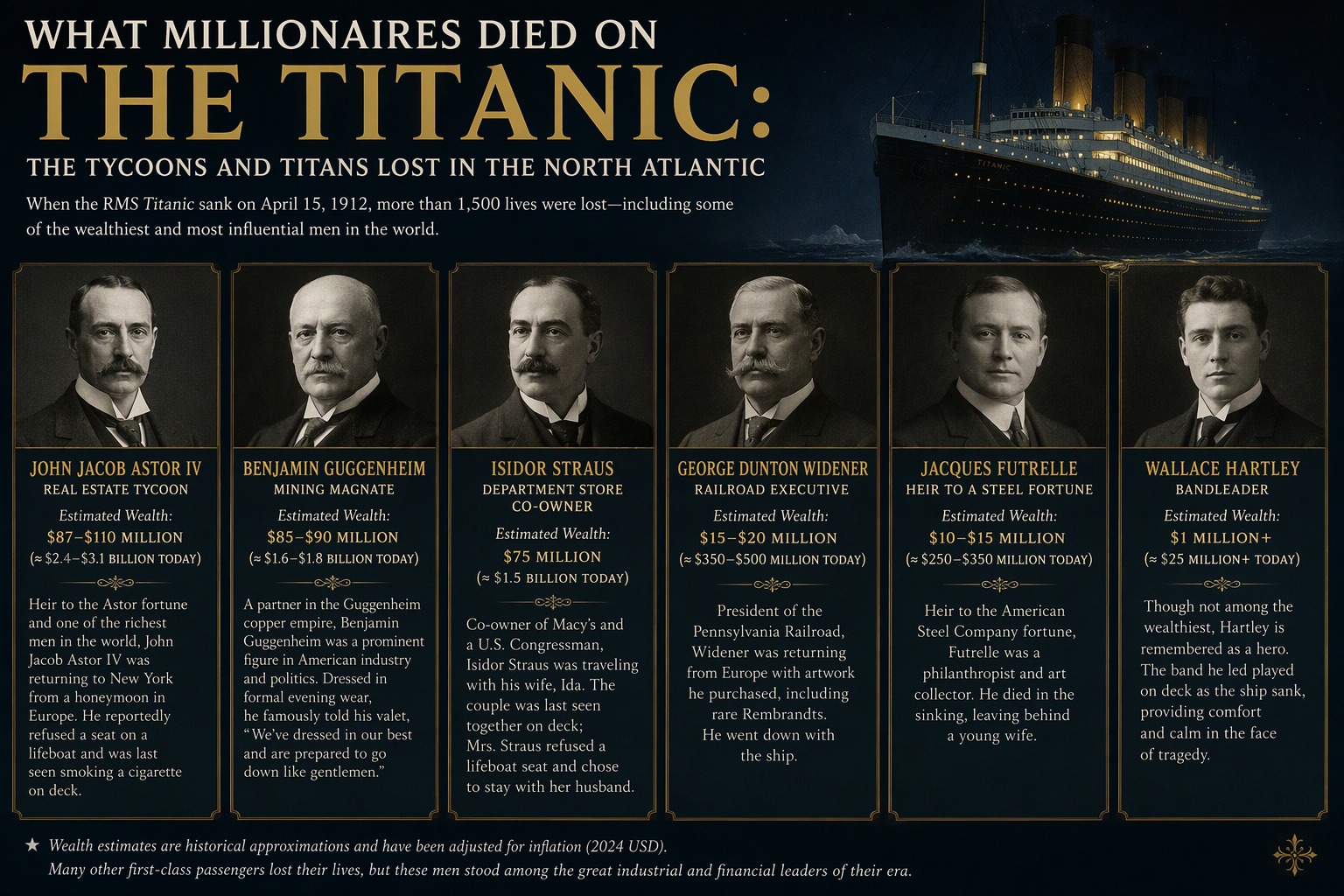
Picture this: a first-class ticket, a fortune worth billions today, and a cabin on the “unsinkable” RMS Titanic. On the night of April 14, 1912, all three came together in the worst way possible. When historians later tallied how many millionaires died on the Titanic, the answer stunned the world — roughly ten to twelve men of vast wealth went down with the ship, along with about 1,500 other souls.
Some helped their wives into lifeboats before vanishing into the dark. Others dressed in white tie and tails, meeting the end like gentlemen. In this guide, you’ll meet the wealthy dead of the RMS Titanic, learn what their fortunes were worth, and see how their deaths reshaped maritime Law forever.
Key Takeaways
- Around 10–12 confirmed millionaires died in the disaster of April 15, 1912.
- The richest victim was John Jacob Astor IV, worth about $87 million in 1912 — roughly $2.5–3 billion today.
- Other major tycoons lost: Benjamin Guggenheim, Isidor Straus, and George Dunton Widener.
- Several millionaires perished after personally helping their wives into lifeboats.
- Their deaths triggered global reforms: full lifeboat capacity, 24-hour radio watch, and the International Ice Patrol.
What Millionaires Died on the Titanic: The Four Biggest Fortunes
Four names dominate every account of the disaster. Between them, these men controlled real estate empires, mining fortunes, a department-store dynasty, and streetcar networks spanning entire cities.
John Jacob Astor IV — The Richest Man Aboard
John Jacob Astor IV carried the heaviest wallet on the ship. His fortune stood near $87 million in 1912 dollars — a sum most economists convert to somewhere between $2.5 and $3 billion today.
Astor built that wealth through hotels like the Astoria and the Knickerbocker, plus enormous Manhattan real estate holdings. As a result, he was practically American royalty. On the sinking ship, he helped his 18-year-old pregnant wife Madeleine into Lifeboat 4, then politely asked the officer if he could join her because of her delicate condition.
The officer refused. Astor stepped back, patted his dog Kitty, lit a cigar, and disappeared into the crowd. Recovery ships later found his body with a gold pocket watch and a cash clip holding $2,500. Meanwhile, Madeleine survived and gave birth to John Jacob Astor VI five months later.
Benjamin Guggenheim — The Mining Prince
Benjamin Guggenheim represented the second generation of One of America’s great industrial dynasties. His father, Meyer, built a mining and smelting empire, and Benjamin inherited a multi-million-dollar share.
His final hours became legend. After the iceberg strike, Guggenheim and his valet Victor Giglio reportedly shed their lifebelts, changed into full evening dress, and declared: “We’ve dressed up in our best and are prepared to go down like gentlemen.” Witnesses later said he spent his last minutes helping women into boats. However, his body was never recovered from the Atlantic.
Isidor Straus — The Macy’s Co-Owner
Isidor Straus co-owned Macy’s department store and had even served a term in the U.S. Congress. His retail fortune ran to several million dollars, but he is remembered less for money than for devotion.
Straus and his wife Ida were seen sitting side by side on deck chairs as the lifeboats launched. Officers offered Ida a seat, but she refused, famously telling her husband, “Where you go, I go.” As a result, both perished together. Rescuers recovered Isidor’s body; Ida was never found. Their story is still recited at memorial services a century later.
George Dunton Widener — The Streetcar Magnate
George D. Widener ran Philadelphia’s streetcar empire and collected art on the scale of European galleries. He sailed with his son Harry Elkins Widener and their valet, returning from a book-buying trip to England.
None of the three men survived. By contrast, Widener’s wife Eleanor escaped in a lifeboat. Her grief transformed into One of the most lasting legacies of the disaster: she funded Harvard’s Widener Library in her son’s memory, spending well over a million dollars on the project.
More Wealthy Victims: Bankers, Railroad Barons and Theater Kings
Beyond the big four, several other wealthy men lost their lives that night. Their names rarely headline movies, yet each controlled serious money.
- Henry B. Harris — A leading Broadway producer worth millions. He gently pushed his wife René toward a lifeboat, promising to follow on the next One. He never did.
- Charles Melville Hays — President of Canada’s Grand Trunk Railway. He died after urging his womenfolk onto a boat; sailors recovered his body days later.
- Walter Donald Douglas — A St. Paul tycoon whose fortune came from iron and railway machinery. His wife Mahala survived; his body was never found.
- Arthur L. Ryerson — A Chicago steel executive traveling first class. His body was among those recovered by the Mackay-Bennett cable ship.
- Harry Markland Molson — Of the Molson brewing and banking dynasty of Montreal. He perished and was never identified among the recovered dead.
- John P. Thayer — A vice president of the Pennsylvania Railroad. He went down despite his wife Marian’s desperate escape in a lifeboat.
Not every famous victim was rich. Editor William Thomas Stead, presidential aide Archibald Butt, and muralist Francis Davis Millet also died. Therefore, the casualty list cut across wealth, profession, and nationality alike.
Translating 1912 Millions Into Today’s Money
Talking about $87 million sounds impressive, but the real shock comes from conversion. Inflation calculators suggest Astor’s fortune equals roughly $2.7 billion today. The other tycoons’ estates ranged from a few million to perhaps twenty million in period dollars.
| Name Approx | x. Fortune (1912) | Modern Equivalent |
|---|---|---|
| John Jacob Astor IV | $87 million | $2.5–3 billion |
| Benjamin Guggenheim | Several million | $100 million+ |
| Isidor Straus | Several million | $100 million+ |
| George D. Widener | $10–20 million | $300–600 million |
Another useful lens is gold. Back then, the dollar was anchored to gold at $20.67 per ounce. Today’s bullion prices are multiples of that floor, which partly explains why old fortunes feel so staggering. If you enjoy tracking what precious metal really costs per gram, our breakdown of Tanishq gold rates shows how dramatically prices have moved.
Currency conversion adds yet another layer of distortion. Even modern transfers carry hidden spreads, a point we explore in our piece on the Canara Bank INR to GBP rate. Needless to say, the nominal number never tells the whole story.
The Rich Who Lived: Fortunes That Survived the Atlantic
Death took a vicious toll, yet not every wealthy passenger joined it. Widows Madeleine Astor and Eleanor Widener survived, along with their maids. “Unsinkable” Molly Brown escaped and later became a folk hero. Sir Cosmo Duff-Gordon and his wife Lucy made it off — though a payment to their boat’s crew sparked a bribery scandal.
Bruce Ismay, chairman of the White Star Line, survived and spent the rest of his life in disgrace. J. Pierpont Morgan, whose company owned the line, had booked passage but canceled at the last minute. As a result, the man who profited most from the ship never set foot on its deck.
The contrast between inherited Gilded Age empires and today’s self-made tech fortunes is striking. If that comparison fascinates you, read how Jay Chaudhry built Zscaler from a Himalayan village to billions, and how Dario Amodei’s Anthropic fortune reflects the AI era’s different kind of wealth creation.
After the Iceberg: Reforms Triggered by Their Deaths
The loss of so many wealthy, well-connected men forced governments to act. American and British inquiries both concluded that speed, complacency, and inadequate lifeboat drills caused the catastrophe.
As a direct result, the 1914 SOLAS convention mandated lifeboats for everyone aboard, round-the-clock wireless monitoring, and a dedicated ice patrol in the North Atlantic. Ships could no longer legally sail half-equipped simply because their owners called them unsinkable.
The financial fallout hit hard too. Estates settled claims for years, insurance disputes piled up, and the White Star Line never fully recovered its reputation. Meanwhile, the Astor and Widener families quietly channeled grief into trusts and libraries that still operate today.
Conclusion
So what millionaires died on the Titanic? Astor, Guggenheim, Straus, Widener — plus a cluster of railroad barons, bankers, and producers whose combined losses reached nine figures in period dollars. Their deaths proved that the North Atlantic respected neither pedigree nor pocketbook. Nevertheless, their legacies survived in courtrooms, in maritime Law, and in stone buildings like Harvard’s Widener Library.
Frequently Asked Questions
Who was the richest millionaire who died on the Titanic?
John Jacob Astor IV was by far the wealthiest victim. His estate was valued at about $87 million in 1912, which translates to roughly $2.5–3 billion in modern terms. His body was recovered, but most of his fellow tycoons vanished beneath the waves.
How many millionaires died on the Titanic?
Historians generally agree that about 10 to 12 confirmed millionaires perished out of roughly 2,200 people aboard. The core group includes Astor, Guggenheim, Straus, Widener, Harris, Hays, Douglas, Ryerson, Molson, and Thayer. Counts vary slightly because wealth estimates from 1912 are imprecise.
Did any wealthy passengers survive the Titanic?
Yes. Madeleine Astor, Eleanor Widener, Margaret “Molly” Brown, and the Duff-Gordons all survived. White Star Line chairman J. Bruce Ismay escaped as well, though he faced public outrage afterward. J. Pierpont Morgan, who effectively owned the shipping line, canceled his passage and never boarded.
What happened to John Jacob Astor IV’s fortune after he died?
The bulk of the estate passed to his son Vincent Astor from his first marriage. His unborn son, John Jacob Astor VI, received a substantial trust, and his widow, Madeleine, enjoyed a generous income under strict conditions. The Astor wealth remained influential in New York real estate and philanthropy for decades.
Why did some millionaires give up their lifeboat spots?
Officers enforced a “women and children first” policy, and many men honored that code even at mortal risk. Astor, Hays, and Harris all saw their wives safely off before staying behind. Social expectations of gallantry, combined with early confusion about the ship’s true danger, sealed their decisions.
Keep Exploring Wealth, Risk, and Legacy
From Gilded Age titans to modern tech billionaires, the stories behind great fortunes are stranger than fiction. Dive deeper into our latest features: