
Navigating the AI Uncertainty: Why Strategic AI Automation and Consulting Services Are Essential in a Shifting Landscape
Estimated reading time: 8 minutes
- The AI landscape is shifting from pure possibility to a more cautious, strategic approach, influenced by figures like Bill Gates.
- “Shadow AI” poses significant security risks due to unvetted employee use of third-party tools.
- Responsible AI implementation requires a focus on governance, orchestrated automation (e.g., with n8n), and Human-in-the-Loop systems.
- Professional AI automation and consulting services help businesses navigate risks, optimize processes, and achieve secure, efficient AI integration.
- Strategic AI adoption involves moving from experimental “prompt engineering” to structured “workflow engineering” for tangible business outcomes.
Table of Contents
- The Great AI Debate: Understanding the Risks and the Counter-Arguments
- Moving from “Shadow AI” to Managed Automation
- The Pillars of Responsible AI Implementation
- How AI TechScope Bridges the Gap
- Practical Takeaways for the Tech-Forward Leader
- Conclusion: Turn Uncertainty into Opportunity
The Great AI Debate: Understanding the Risks and the Counter-Arguments
The tech world is currently vibrating with a mix of breathless excitement and profound apprehension. For the past eighteen months, the narrative surrounding artificial intelligence has been one of pure, unadulterated possibility—a “gold rush” of generative tools and unprecedented capabilities. However, recent developments suggest that even the most optimistic architects of the digital age are beginning to pause. Recently, Bill Gates expressed significant concerns regarding the trajectory of artificial intelligence, signaling a shift in how the global elite view the rapid deployment of these technologies. For business leaders, entrepreneurs, and tech-forward executives, this news highlights a critical need for professional AI automation and consulting services to navigate the complex intersection of innovation and risk.
When a figure as influential as Bill Gates “hits the panic button,” it is not a signal to retreat from technology, but rather a signal to change *how* we approach it. The debate is no longer just about what AI *can* do, but about what AI *should* do, and how we can implement it without compromising security, ethics, or operational stability. In this newsletter, we will dissect the current tensions in the AI landscape, analyze the divide between industry titans and technical experts, and provide a roadmap for how your business can leverage AI through structured, intelligent automation rather than chaotic experimentation.
The recent headlines regarding Bill Gates’ diagnosis of AI problems have sent ripples through the boardroom. Gates has pointed toward several systemic risks that could arise if the current trajectory of AI development remains unchecked. These concerns typically fall into three categories: the socioeconomic impact of massive job displacement, the potential for AI-generated misinformation to destabilize social trust, and the existential risks associated with “black box” algorithms that humans can no longer fully interpret or control.
Gates’ “prescription”—essentially a call for more stringent oversight and a more cautious approach to deployment—has met with pushback from other industry experts. These skeptics argue that over-regulation or a “panic-driven” slowdown could stifle the very innovations needed to solve humanity’s most pressing problems, from climate change to medical breakthroughs. They suggest that the solution isn’t to slow down, but to build better, more transparent frameworks within the technology itself.
For the business professional, this debate is more than just academic. It represents the “Governance vs. Growth” dilemma. If you move too slowly, your competitors will capture the efficiency gains of AI. If you move too fast without a strategic framework, you risk data breaches, algorithmic bias, and the “hallucination” problem where AI provides confidently wrong information that can lead to disastrous business decisions.
This is precisely where the value of professional AI automation and consulting services becomes apparent. The goal for a modern enterprise is to find the “Golden Middle”—the space where you reap the rewards of rapid technological advancement while maintaining the guardrails of enterprise-grade security and reliability.
Moving from “Shadow AI” to Managed Automation
One of the most significant risks identified in the current AI climate is the rise of “Shadow AI.” This occurs when employees at various levels of an organization begin using unvetted, third-party AI tools to perform their daily tasks—perhaps to summarize meetings, write emails, or analyze sensitive spreadsheets—without the knowledge or permission of the IT department.
While this shows a healthy appetite for efficiency, it creates a massive security vacuum. When an employee pastes proprietary company data or client information into a public LLM (Large Language Model), that data may be used to train future iterations of the model, effectively leaking your intellectual property into the public domain.
This is why digital transformation must be a top-down strategy rather than a bottom-up accident. Instead of allowing employees to use fragmented, unmanaged tools, businesses must implement centralized, automated workflows. By utilizing sophisticated orchestration tools like n8n, companies can create “walled gardens” of automation. In an n8n-driven workflow, data flows through secure, permissioned API connections rather than being dumped into a public chat interface. This allows you to harness the power of AI while maintaining absolute control over your data sovereignty.
The Pillars of Responsible AI Implementation
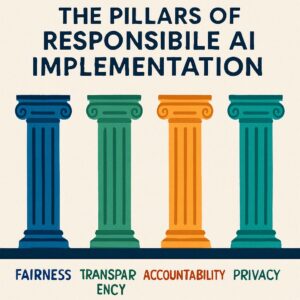
To avoid the pitfalls that concern industry leaders like Gates, businesses must move away from “prompt engineering” as a primary strategy and toward “workflow engineering.” We recommend a three-pillar approach to AI integration:
1. Governance and Data Integrity
Before a single AI tool is deployed, a business must define its data governance policy. Which data is “AI-ready”? Which data is strictly off-limits? A professional consulting partner helps you establish these boundaries, ensuring that your AI implementations are compliant with global regulations (like GDPR or CCPA) and internal security protocols.
2. Orchestrated Automation (The n8n Advantage)
The future of business efficiency does not lie in a single “AI bot” that does everything. It lies in the seamless orchestration of multiple specialized agents. Using n8n workflow development, we help businesses build complex, multi-step automations.
For example, instead of a human manually checking an email, summarizing it, and updating a CRM, an n8n workflow can:
- Trigger upon receipt of a specific email.
- Use an AI agent to categorize the sentiment and urgency.
- Extract key data points (names, dates, contract values).
- Update your CRM (like Salesforce or HubSpot) automatically.
- Draft a response in your brand voice for human approval.
- Alert the relevant department via Slack or Microsoft Teams.
This isn’t just “using AI”; it is building a digital nervous system for your company.
3. Human-in-the-Loop (HITL) Systems
One of the core fears expressed by tech critics is the loss of human agency. To mitigate this, we advocate for “Human-in-the-Loop” systems. This means designing AI workflows where the machine performs the heavy lifting—the data gathering, the sorting, the initial drafting—but a human expert provides the final validation. This approach maximizes speed while eliminating the risks of AI hallucinations and errors.
How AI TechScope Bridges the Gap
At AI TechScope, we recognize that the current “AI panic” is actually a call for professionalization. The era of “playing around with ChatGPT” is over; the era of “integrated AI intelligence” has begun. Our mission is to help businesses transition from the experimental phase to the implementation phase.
We specialize in turning the theoretical potential of AI into tangible business outcomes through several core service areas:
AI-Powered Automation & n8n Development
We don’t just give you tools; we build systems. Our expertise in n8n workflow development allows us to create custom, automated pipelines that connect your existing software stack to the world’s most powerful AI models. We specialize in reducing “manual friction”—those repetitive, soul-crushing tasks that drain your team’s productivity and increase the likelihood of human error.
Strategic AI Consulting
The debate between Bill Gates and industry experts proves that there is no one-size-fits-all answer to the AI revolution. Our consulting services are designed to help you find *your* specific answer. We conduct deep dives into your current business processes to identify high-impact opportunities for automation and help you build a roadmap for digital transformation that is both ambitious and safe.
Intelligent Website Development & Integration
Your website is often the first point of contact for your customers and the primary interface for your brand. We develop high-performance, AI-integrated websites that do more than just look good. We build web environments that can leverage intelligent chatbots, personalized user experiences, and automated lead-capture workflows, ensuring that your digital presence is as efficient as your internal operations.
Business Process Optimization
True efficiency isn’t just about doing things faster; it’s about doing the *right* things. We use AI to analyze your workflows, identifying bottlenecks and redundancies that may have been invisible to the naked eye. By optimizing these processes, we help you scale your operations without a linear increase in headcount, allowing you to maintain high margins even as you grow.
Practical Takeaways for the Tech-Forward Leader
As you navigate the headlines and the shifting tides of the AI industry, keep these actionable strategies in mind:
- Audit Your “Shadow AI”: Conduct an internal survey or use network monitoring to see which AI tools your employees are currently using. Bring those activities into a managed, secure environment.
- Prioritize “Boring” Automation First: Don’t start by trying to build a creative AI that writes your marketing strategy. Start by automating your invoicing, your lead routing, or your customer support ticketing. Master the high-reliability tasks first.
- Invest in Orchestration, Not Just Models: A powerful LLM is a commodity; a powerful, interconnected workflow is a competitive advantage. Focus on how your tools *talk to each other*.
- Focus on Scalability through Delegation: View AI not as a replacement for your team, but as a way to provide every team member with a “digital assistant.” The goal is to move your human talent from “doing” to “managing” and “strategizing.”
Conclusion: Turn Uncertainty into Opportunity
The “panic” expressed by leaders like Bill Gates is a symptom of a world in transition. When the foundations of how we work, communicate, and create are being rewritten, it is natural to feel a sense of vertigo. However, for the prepared leader, this uncertainty is actually a massive opportunity.
The companies that will dominate the next decade are not the ones that rushed into every new AI trend, nor the ones that retreated in fear. The winners will be those who implemented AI with precision, strategy, and a focus on structured automation. They will be the ones who moved past the hype and built robust, intelligent systems that drive real-world efficiency.
Don’t leave your company’s digital transformation to chance or to unmanaged “Shadow AI.” Partner with experts who understand how to harness the power of this technology responsibly and effectively.
Ready to transform your business through intelligent automation?
At AI TechScope, we help you move from AI curiosity to AI mastery. Whether you need custom n8n workflows, strategic consulting to guide your digital transformation, or an AI-optimized web presence, our team is ready to help you scale.
Frequently Asked Questions
What is “Shadow AI” and why is it a concern?
“Shadow AI” refers to the use of unvetted, third-party AI tools by employees without the organization’s IT department’s knowledge or permission. It’s a concern because it can lead to severe security vulnerabilities, data leaks of proprietary or client information, and a lack of compliance with internal policies and external regulations.
How does n8n help with AI automation?
n8n is an open-source workflow automation tool that allows businesses to create secure, centralized, and automated workflows. It connects various applications and AI models through secure API connections, preventing data from being exposed to public AI platforms and enabling controlled data flow within a company’s “walled garden” of automation.
What is the difference between “prompt engineering” and “workflow engineering” in AI implementation?
Prompt engineering focuses on crafting effective text prompts to get specific outputs from AI models. Workflow engineering, on the other hand, involves designing and automating a series of interconnected steps or tasks using AI and other tools. Workflow engineering is a more strategic and structured approach for enterprise-level AI integration, moving beyond individual AI interactions to build comprehensive business processes.
What are the main risks highlighted by Bill Gates regarding AI development?
Bill Gates has expressed concerns about three main areas: the socioeconomic impact of massive job displacement due to AI, the potential for AI-generated misinformation to destabilize social trust, and the existential risks associated with increasingly complex “black box” AI algorithms that may become difficult for humans to fully understand or control.
How can businesses find the “Golden Middle” in AI adoption?
The “Golden Middle” in AI adoption refers to achieving a balance between leveraging the benefits of rapid technological advancement and maintaining enterprise-grade security and reliability. This is achieved through strategic planning, robust governance, managed automation (like using n8n), and implementing Human-in-the-Loop systems to ensure human oversight and validation.