

Navigating AI Regulatory Landscapes: Lessons from the Anthropic Export Control Crisis
Estimated reading time: 7 minutes
Key Takeaways
- The AI landscape is rapidly evolving, with regulatory boundaries becoming crucial for businesses.
- Recent export controls on Anthropic’s models highlight the geopolitical implications of advanced AI.
- “Deemed exports” and the dual-use nature of frontier AI models are central to national security concerns.
- Regulatory volatility creates significant business risks, emphasizing the need for strategic resilience.
- Model agnosticism and modular automation are key to navigating AI regulatory landscapes.
Table of Contents
- The Anthropic Incident: A New Precedent in AI Governance
- Understanding the Complexity: Why AI is Now a Matter of National Security
- The Ripple Effect: How Regulatory Volatility Impacts Business Efficiency
- Strategic Resilience: Navigating AI Regulatory Landscapes through Automation
- Practical Takeaways for Business Leaders
- How AI TechScope Empowers Your Digital Transformation
The Anthropic Incident: A New Precedent in AI Governance
The rapid evolution of artificial intelligence has brought us to a precipice where the boundaries between technological innovation and national security are becoming increasingly blurred. For business leaders and entrepreneurs, the ability to stay ahead of the curve is no longer just about knowing which model is the most powerful; it is about navigating AI regulatory landscapes that can shift overnight. This week, the tech world was rocked by an unprecedented development involving Anthropic, one of the industry’s most prominent AI research companies. The sudden imposition of export controls on their latest models has sent shockwaves through the global business community, serving as a stark reminder that the “wild west” era of AI is rapidly coming to an end.
In this edition of our industry deep-dive, we analyze the implications of the recent Anthropic shutdown, explore the technical and legal nuances of AI export controls, and provide a strategic roadmap for businesses to build resilient, automation-driven workflows that can withstand the volatility of emerging government regulations.
The headlines this week were dominated by a sudden and disruptive move by the U.S. administration. Anthropic, the creators of the highly acclaimed Claude series, found itself in a defensive struggle to maintain access to its most advanced models, Fable 5 and Mythos 5. The government issued an abrupt order requiring Anthropic to restrict access to these models for all foreign nationals.
What makes this particular event so unprecedented is the scope of the restriction. This was not merely a ban on users located overseas; the order was broad enough to include foreign nationals residing within the United States, and in some instances, even affected the company’s own global workforce. This represents a fundamental shift in how AI technology is treated by regulatory bodies.
According to reports from *The Verge*, this marks the first time that U.S. export controls have been weaponized to govern access to a specific AI model in this manner. While the administration cited “national security authorities” as the justification, the lack of a detailed legal explanation has left the industry in a state of uncertainty. For the first time, the “weights” and “inference capabilities” of a Large Language Model (LLM) are being treated with the same level of scrutiny as high-end semiconductor manufacturing or nuclear technology.
Understanding the Complexity: Why AI is Now a Matter of National Security
To understand why this is happening, we must look at the concept of “deemed exports” and the strategic value of frontier models. In traditional trade law, an export occurs when a product is sent abroad. However, a “deemed export” occurs when sensitive technology or information is shared with a foreign national *within* the domestic borders of a country.
As models like Fable 5 and Mythos 5 achieve higher levels of reasoning, coding ability, and autonomous problem-solving, they are no longer viewed simply as “software products.” They are increasingly seen as dual-use technologies—tools that have significant commercial applications but also possess the potential to advance military capabilities, cyber warfare, or large-scale disinformation campaigns.
When a government decides to implement export controls on an AI model, they are essentially attempting to create a “technological moat.” The goal is to ensure that the most advanced cognitive tools remain under the control of domestic interests, preventing adversarial nations from leveraging these models to leapfrog current technological standards.
For the business professional, this creates a new category of risk: Regulatory Model Risk. If your entire digital infrastructure, customer service pipeline, or data analysis engine relies on a single provider like Anthropic, a sudden change in the regulatory climate could effectively shut down your operations in a matter of hours.
The Ripple Effect: How Regulatory Volatility Impacts Business Efficiency
The primary casualty of these sudden regulatory shifts is predictability. Business efficiency is built on the foundation of reliable systems. Digital transformation initiatives—where companies integrate AI into their core workflows to optimize costs and scale operations—require a stable technological stack.
When we look at the Anthropic situation, we see several layers of disruption:
- Operational Downtime: Companies that integrated Fable 5 into their real-time decision-making processes or customer-facing chatbots suddenly faced service outages.
- Developmental Stagnation: R&D teams relying on these models to write code or simulate complex scenarios were unable to work, leading to lost momentum and delayed product launches.
- Compliance Complexity: Businesses must now evaluate the “nationality” of their workforce and the location of their data processing to ensure they are not inadvertently violating new, rapidly evolving export laws.
This volatility underscores a critical lesson for the modern entrepreneur: Centralization is a vulnerability. Relying on a single, monolithic AI provider creates a “single point of failure” that is no longer just a technical concern, but a geopolitical one.
Strategic Resilience: Navigating AI Regulatory Landscapes through Automation
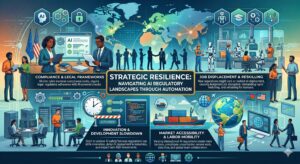
How can businesses protect themselves from the unpredictability of government intervention? The answer lies in moving away from “hard-coded” AI dependencies and moving toward intelligent, modular automation.
The key to surviving in an era of shifting regulations is Model Agnosticism. A model-agnostic approach means designing your business processes so that the underlying AI “brain” can be swapped out without rebuilding the entire “body” of your workflow.
This is where advanced AI automation and workflow orchestration become essential. Instead of building a direct connection between your software and a specific AI API (like Anthropic’s), you should build a layer of abstraction. By using orchestration tools, you create a system where the logic remains constant, but the engine can be changed at a moment’s notice.
Practical Takeaways for Business Leaders
To ensure your organization remains resilient while navigating AI regulatory landscapes, we recommend the following strategic pivots:
1. Diversify Your AI Stack (The “Multi-Model” Strategy)
Never rely on a single LLM for mission-critical tasks. Develop workflows that can utilize a variety of models—such as OpenAI’s GPT series, Google’s Gemini, or open-source alternatives like Meta’s Llama 3. If one provider is hit by a regulatory blockade, your secondary or tertiary models can be “switched on” to maintain continuity.
2. Implement Modular Workflows with n8n
Traditional automation often creates rigid links between tools. By utilizing n8n—a powerful, fair-code workflow automation tool—businesses can build sophisticated, branching logic. For example, an n8n workflow can be programmed to:
- Attempt a task using Anthropic’s Mythos 5.
- If an API error or “access denied” signal is received, automatically reroute the request to an open-source model hosted on your own private servers.
- This “failover” mechanism ensures that your business processes continue to run even during a regulatory crisis.
3. Prioritize Data Sovereignty and Local Hosting
Where possible, move toward “Private AI.” This involves using open-source models that can be hosted on your own cloud infrastructure (AWS, Azure, or Google Cloud) or even on-premise. When you own the model and the infrastructure, you are significantly less vulnerable to the export controls imposed on third-party SaaS providers.
4. Conduct a “Regulatory Audit” of Your AI Workflows
Work with AI consultants to identify which parts of your business are most dependent on specific, high-frontier models. Map out your dependencies and create a “contingency playbook” for each critical process. Knowing exactly what to do when a model goes offline is the difference between a minor hiccup and a total business shutdown.
How AI TechScope Empowers Your Digital Transformation
At AI TechScope, we specialize in helping businesses navigate exactly this kind of complexity. We understand that the goal of AI integration isn’t just to use the “latest and greatest” tool, but to build a sustainable, scalable, and resilient competitive advantage.
Our expertise lies in the intersection of cutting-edge AI and robust business process optimization. We don’t just implement AI; we build the systems that make AI reliable.
- n8n Workflow Development: We are experts in creating modular, “model-agnostic” automations. We design workflows that allow you to swap AI providers seamlessly, ensuring that your business remains operational regardless of the geopolitical climate.
- AI Consulting & Strategy: We help you move beyond the hype. Our consultants work with your leadership team to identify high-impact AI opportunities while simultaneously conducting risk assessments to ensure your AI strategy is built on a foundation of resilience.
- Business Process Optimization: We look at your entire operation to identify where intelligent delegation and automation can reduce costs and improve efficiency. We ensure that your digital transformation is not just a collection of cool tools, but a cohesive, optimized engine for growth.
- Website & Tool Development: We build custom interfaces and internal tools that integrate your AI stack into your existing business ecosystem, providing a seamless experience for both your employees and your customers.
The Anthropic incident is a wake-up call. The era of “plug-and-play” AI is being replaced by an era of “strategic implementation.” As the regulatory environment tightens, the businesses that thrive will be those that have replaced rigid dependencies with flexible, automated, and intelligent systems.
Don’t leave your business’s future to the whims of shifting export controls. Secure your operations and optimize your workflows today.
Explore AI TechScope’s AI Automation and Consulting Services
Ready to build a resilient, AI-powered future? Contact AITechScope today to learn how our expert n8n developers and AI consultants can transform your business processes and protect your digital transformation journey.
FAQ
What are “deemed exports” in the context of AI?
A “deemed export” occurs when sensitive technology or information is shared with a foreign national within a country’s domestic borders, effectively treating it as if it were exported abroad.
Why are AI models now considered a national security concern?
Advanced AI models, particularly frontier models, possess dual-use capabilities. They can be used for significant commercial applications but also have the potential to advance military capabilities, cyber warfare, or large-scale disinformation campaigns, making them a national security issue.
What is “model agnosticism” in AI automation?
Model agnosticism means designing business processes so that the underlying AI model can be swapped out without needing to rebuild the entire workflow. This allows for flexibility and resilience against changes in AI availability or regulation.
How can businesses prepare for AI regulatory volatility?
Businesses can prepare by diversifying their AI stack, implementing modular workflows, prioritizing data sovereignty and local hosting, and conducting regular “regulatory audits” of their AI dependencies.
What is the role of n8n in building resilient AI workflows?
n8n is a workflow automation tool that allows businesses to build sophisticated, branching logic. It can implement “failover” mechanisms, rerouting tasks to different AI models if a primary one becomes inaccessible due to regulatory issues, thus ensuring business continuity.