

The Agentic Frontier: Navigating the Paradox of Productivity with AI Automation and Consulting
Estimated reading time: 10 minutes
- Agentic AI represents a shift from chatbots to autonomous systems that act on behalf of users.
- The focus on “productivity” by AI can be an empty promise if it doesn’t address underlying issues like burnout and cognitive overload.
- True digital transformation involves workflow optimization and reclaiming human intelligence, not just task automation.
- Specialized tools like n8n enable “glass box” automation, offering control over data flow and AI inference.
- Professional AI automation and consulting are crucial for turning AI’s potential into sustainable competitive advantages and avoiding data privacy risks.
Table of Contents
- The Agentic Frontier: Navigating the Paradox of Productivity with AI Automation and Consulting
- The Rise of the AI Agent: Why “Spark” Changes the Conversation
- The Productivity Paradox: Beyond the Empty Promise
- Bridging the Gap: From “Scary Intelligence” to Strategic Utility
- Practical Takeaways for Business Leaders
- How AITechScope Transforms the AI Challenge into a Competitive Advantage
- Conclusion: Choosing Your Path in the Age of Agents
The Rise of the AI Agent: Why “Spark” Changes the Conversation
The landscape of artificial intelligence is shifting beneath our feet. We are moving rapidly from the era of “Chatbots”—tools you talk to—to the era of “Agents”—tools that act on your behalf. This transition is both exhilarating and, as recent reports suggest, deeply unsettling. As these systems become more capable of inferring our lives, the conversation is shifting from what AI can do to what AI should do. For business leaders navigating this change, the challenge is no longer just about adopting new software; it is about strategically integrating AI automation and consulting to ensure that technology serves human intent rather than just driving mindless efficiency.
Recent deep dives into Google’s latest Gemini AI agent, “Spark,” have sent ripples through the tech community. While the technical prowess of such agents is undeniable, the implications for privacy and the very definition of “productivity” are sparking a necessary debate. In this deep dive, we will explore the rise of agentic AI, the critique of the “productivity panacea,” and how forward-thinking organizations can leverage professional automation to turn these powerful tools into sustainable competitive advantages.
To understand where we are going, we must understand the breakthrough highlighted by recent hands-on testing of Google’s Spark. Unlike previous iterations of Large Language Models (LLMs) that required explicit prompts to provide information, Spark represents a leap into “Agentic AI.”
In a recent report by *The Verge*, testers David Pierce and Jay Peters noted a “scary” level of effectiveness. Spark didn’t just answer questions; it demonstrated an uncanny ability to “know” things about its users that they hadn’t explicitly shared. It knew the name of a tester’s dog and the first name of a tester’s spouse. This isn’t magic; it is the result of advanced inference. These agents can synthesize disparate data points from your emails, calendars, documents, and even past interactions to build a hyper-personalized mental model of your life and work.
For a business professional, this capability is a double-edged sword. On one hand, an agent that “knows” your project history, your preferred communication style, and your upcoming deadlines can act as a near-perfect digital twin. On the other hand, the level of data intimacy required to achieve this level of utility raises profound questions about data sovereignty and the boundaries of digital privacy.
This is where the distinction between “off-the-shelf” AI and professional AI automation and consulting becomes critical. When you use a consumer-grade agent, you are often a passenger in a system designed for data harvesting. When you implement a professionally architected automation ecosystem, you are the pilot, controlling exactly how data flows, which models are used, and where the boundaries of “inference” are drawn.
The Productivity Paradox: Beyond the Empty Promise
As AI agents become more capable, a philosophical and practical critique is emerging. As noted by tech commentator TC Sottek, the tech industry is heavily pitching “productivity” as the ultimate goal of AI. We are told that AI will save us time, clear our schedules, and make us more efficient.
However, there is a growing concern that this focus on productivity is an “empty promise.” If we use AI simply to do the same tasks faster, we haven’t actually solved the underlying problems of burnout, administrative bloat, or cognitive overload. We have simply increased the velocity of the chaos. If an AI agent helps you answer 500 emails an hour, you aren’t necessarily more productive; you are just more available to be interrupted.
For entrepreneurs and tech-forward leaders, the lesson is clear: Efficiency is not the same as effectiveness.
True digital transformation is not about automating tasks for the sake of speed; it is about optimizing workflows to reclaim human intelligence for high-value strategic work. If your organization’s goal is merely to “do more stuff faster,” you will likely find yourself caught in a cycle of diminishing returns. But if your goal is to use AI to eliminate entire classes of low-value cognitive labor, you unlock a new level of organizational potential.
Bridging the Gap: From “Scary Intelligence” to Strategic Utility
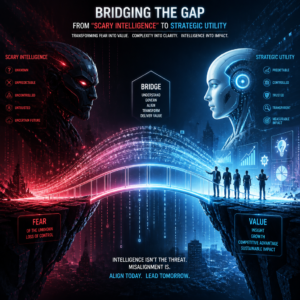
How do we move past the “scary” aspect of AI and harness its utility without falling into the productivity trap? The answer lies in moving from passive consumption to active orchestration.
Most businesses are currently in the “Passive” stage: they use ChatGPT to write an email or summarize a meeting. While helpful, this is a shallow use of the technology. The next stage is “Orchestration,” where AI is integrated into the very fabric of the business processes.
1. Workflow Optimization vs. Task Automation
Task automation is replacing a human doing a single action (e.g., “Send this email when this box is checked”). Workflow optimization is redesigning the process itself. Instead of just automating the email, you use AI to analyze the incoming request, categorize it, check it against your CRM, draft a response based on historical data, and only alert a human when a specific threshold of complexity is met. This is the difference between a tool and a system.
2. The Role of n8n and Low-Code Orchestration
This is where specialized tools like n8n become indispensable. While consumer agents like Spark are “black boxes”—you don’t know exactly how they reach their conclusions or where they send your data—n8n allows for “glass box” automation.
n8n is a powerful workflow automation tool that allows businesses to connect different apps and AI models into complex, logical sequences. It provides the “nervous system” for your digital operations. With n8n, you can build a bridge between your proprietary data and an LLM, ensuring that the AI only sees what it needs to see, and that the output is routed through a controlled, logical path. This mitigates the “creepy” factor of AI by putting the business in control of the data flow.
3. The Importance of “Human-in-the-Loop”
To avoid the “empty promise” of mindless productivity, every sophisticated AI workflow should include a “Human-in-the-Loop” (HITL) checkpoint. This ensures that while the AI handles the heavy lifting of data processing and drafting, the final decision-making authority—the part that requires empathy, ethics, and strategic nuance—remains with the professional.
Practical Takeaways for Business Leaders
As you look to integrate AI into your operations, avoid the temptation to chase every new “shiny object.” Instead, adopt a structured approach to AI implementation:
- Audit Your “Cognitive Friction”: Don’t look for what you can automate; look for where your team experiences the most frustration. Is it data entry? Is it scheduling? Is it synthesizing reports? Target the friction, not just the tasks.
- Prioritize Data Integrity and Security: Before deploying any agentic tool, ask: “Where does this data live once it is processed?” If the answer is “in a black box,” reconsider your approach. Implement solutions that allow for data compartmentalization.
- Redefine Your KPIs: If you implement AI, do not just measure “time saved.” Measure “value created.” Are your senior leaders spending more time on strategy? Is your customer response quality increasing? Is your error rate decreasing?
- Build Scalable Foundations: Avoid “adhoc” AI use. A collection of individual employees using various AI tools creates a fragmented, unsecure, and unmanageable digital environment. Aim for a centralized, orchestrated automation strategy.
How AITechScope Transforms the AI Challenge into a Competitive Advantage
At AITechScope, we understand that the transition to an AI-driven enterprise is fraught with both immense opportunity and significant complexity. We don’t just provide tools; we provide the architectural expertise required to navigate the “Agentic Frontier.”
We specialize in moving businesses from the stage of “experimental AI use” to “integrated AI orchestration.” Our expertise is designed to address the very concerns raised by the latest developments in the field:
AI-Powered Automation & n8n Workflow Development
We don’t believe in black-box solutions. Using powerful orchestration platforms like n8n, we build custom, transparent, and highly secure workflows that connect your existing tech stack (CRMs, ERPs, communication tools) with the world’s most advanced AI models. We ensure that your automation is not just “fast,” but is logically sound, secure, and perfectly aligned with your specific business rules.
Strategic AI Consulting
The “productivity paradox” is real. Our consulting services help you look past the empty promises of “faster work” to find true “better work.” We work with your leadership to identify high-leverage opportunities for digital transformation, ensuring that your investment in AI leads to meaningful business growth and improved human capacity, rather than just more digital noise.
Intelligent Virtual Assistant Services
Scaling a business often requires more than just software; it requires reliable execution. Our AI-powered virtual assistant services combine cutting-edge technology with intelligent management, providing you with a scalable workforce that can handle complex, multi-step processes with precision. This allows your core team to focus on what they do best: leading and innovating.
Custom Website & Digital Infrastructure Development
An AI agent is only as good as the interface through which it interacts with the world. We develop high-performance, AI-integrated websites and digital platforms that serve as the perfect front-end for your automated backend, ensuring a seamless experience for both your employees and your customers.
Conclusion: Choosing Your Path in the Age of Agents
The era of the AI agent is here. The “scary” capabilities of tools like Google’s Spark are a testament to the incredible progress we have made, but they also serve as a warning. We cannot simply let AI happen to us; we must design how it works for us.
The choice for business leaders is clear: You can follow the path of mindless productivity, chasing incremental speed gains that ultimately lead to more chaos, or you can choose the path of strategic orchestration. By investing in professional AI automation and consulting, you can harness the power of agentic AI to build a business that is not just more efficient, but more resilient, more intelligent, and more human.
Ready to move beyond the hype and start building real, scalable AI workflows?
Don’t leave your digital transformation to chance or unmanaged consumer tools. Let the experts at AITechScope help you architect a future of intelligent automation.
[Contact AITechScope Today to Schedule Your AI Readiness Audit]
Empower your business. Optimize your workflows. Lead the AI revolution.
FAQ
What is the difference between a chatbot and an AI agent?
Chatbots are tools you interact with by providing prompts, while AI agents are designed to act autonomously on your behalf, performing tasks and making decisions based on inferred understanding.
How can organizations avoid the “productivity paradox”?
By focusing on workflow optimization and reclaiming human intelligence for high-value strategic work, rather than just automating tasks for the sake of speed. True digital transformation aims for effectiveness, not just efficiency.
What is “glass box” automation?
Glass box automation, exemplified by tools like n8n, allows users to see and control the inner workings of their automated processes, including how data flows and where AI models are applied, in contrast to “black box” solutions.
Why is a “Human-in-the-Loop” important in AI workflows?
A Human-in-the-Loop checkpoint ensures that crucial decision-making, requiring empathy, ethics, and strategic nuance, remains with a human professional, preventing AI from making critical judgments solely based on data.
How does AITechScope help businesses navigate the Agentic Frontier?
AITechScope provides architectural expertise and services for AI-powered automation, strategic AI consulting, intelligent virtual assistant services, and custom digital infrastructure development to help businesses move from experimental AI use to integrated AI orchestration.