

Navigating Economic Shifts: The Imperative of AI Automation for Business Resilience
Estimated reading time: 13 minutes
Key Takeaways
- AI Automation is a Strategic Imperative: In today’s volatile economic landscape, AI automation moves beyond mere efficiency, becoming a critical strategy for businesses to achieve operational resilience, adapt to market shifts, and ensure long-term sustainability.
- Multifaceted Benefits of AI: Implementing AI automation leads to significant cost reduction, increased efficiency and speed, enhanced accuracy, improved scalability, better decision-making, and greater business continuity across various operations.
- Key AI Trends Driving Resilience: Advanced trends such as Generative AI, Hyperautomation, and Predictive Analytics provide practical tools for innovation, end-to-end workflow optimization, proactive problem-solving, and data-driven strategic planning.
- Customer Experience & Ethical Considerations: AI enables personalization at scale, elevating customer experience and loyalty. Simultaneously, ethical deployment—addressing bias, ensuring transparency, and maintaining human oversight—is crucial for building trust and brand reputation.
- Actionable Steps for Implementation: Businesses should identify high-impact automation opportunities, start with pilot projects, invest in AI literacy, prioritize data quality, foster a culture of continuous improvement, and seek expert guidance to successfully integrate AI.
Table of Contents
- The Imperative for AI Automation for Business Resilience
- Deep Dive into AI Trends & Practical Applications Driving Resilience
- Practical Takeaways for Your Business
- AI TechScope’s Role: Empowering Your AI Automation for Business Resilience Journey
- Navigating the Future with AI
- Ready to Build Your Resilient, AI-Powered Future?
In today’s rapidly evolving economic landscape, adaptability is not just an advantage—it’s a fundamental necessity for survival and growth. Businesses, regardless of their size or sector, are constantly challenged by fluctuating markets, technological disruptions, and shifting consumer expectations. The ability to pivot, optimize, and maintain operational stability in the face of uncertainty is paramount. This is where AI Automation for Business Resilience emerges as a critical strategy, transforming how organizations approach efficiency, risk management, and long-term sustainability.
We live in an era where even the most groundbreaking and innovative companies, like SpaceX, can experience significant shifts in market valuation, as evidenced by recent reports indicating their stock dipping below its IPO price for the first time. While the specifics of such market movements are complex and multi-faceted, they serve as a potent reminder that no entity is immune to economic pressures or the need for sustained efficiency and strategic foresight. In such dynamic environments, businesses that can rapidly adapt, streamline operations, and intelligently allocate resources are the ones best positioned to not only weather the storm but emerge stronger. This calls for more than just traditional cost-cutting; it demands a fundamental re-evaluation of how work gets done, and artificial intelligence, particularly through AI Automation for Business Resilience, provides the powerful tools to lead this transformation.
The conversation around AI often centers on its capacity for innovation and breakthrough discoveries, and rightly so. However, its immediate and most profound impact for many businesses lies in its ability to fortify core operations, automate repetitive tasks, enhance decision-making, and create unprecedented levels of operational resilience. For business professionals, entrepreneurs, and tech-forward leaders, understanding and implementing AI automation is no longer a luxury; it’s an essential component of a robust and future-proof business strategy.
The Imperative for AI Automation for Business Resilience
The global economy is a turbulent sea, and businesses are ships that must be built to withstand its unpredictable currents. From supply chain disruptions to rapid changes in consumer behavior and competitive pressures, the challenges are incessant. The recent market signal of even a titan like SpaceX facing valuation adjustments underscores a broader truth: efficiency, agility, and robust operational frameworks are more crucial than ever. It’s not enough to be innovative; businesses must also be exceptionally resilient.
AI Automation for Business Resilience offers a powerful antidote to this volatility. It enables businesses to achieve greater efficiency, reduce operational costs, and enhance their capacity to respond to unexpected events without compromising quality or agility. By delegating repetitive, rule-based tasks to intelligent systems, human talent can be reallocated to strategic initiatives that foster innovation, deepen customer relationships, and drive growth. This not only optimizes resource utilization but also builds an intrinsic resistance to market shocks, ensuring that critical operations continue uninterrupted even during periods of stress.
The strategic adoption of AI automation can lead to:
- Cost Reduction: Automating tasks like data entry, customer service inquiries, and report generation significantly lowers labor costs and minimizes errors.
- Increased Efficiency and Speed: AI systems operate 24/7, processing vast amounts of data and executing tasks far faster than humans, accelerating workflows and improving turnaround times.
- Enhanced Accuracy: AI-driven automation eliminates human error in repetitive tasks, leading to higher quality outputs and more reliable data.
- Improved Scalability: Automated processes can be easily scaled up or down to meet changing demands, providing unparalleled flexibility during periods of growth or contraction.
- Better Decision-Making: AI analyzes data patterns to provide actionable insights, empowering leaders to make more informed and strategic decisions.
- Greater Business Continuity: By automating critical functions, businesses can ensure continuity of operations even when human resources are constrained or disrupted.
These benefits directly contribute to a stronger, more adaptable business model. In an environment where every dollar and every minute counts, leveraging AI to build resilience is not just smart—it’s indispensable.
Deep Dive into AI Trends & Practical Applications Driving Resilience
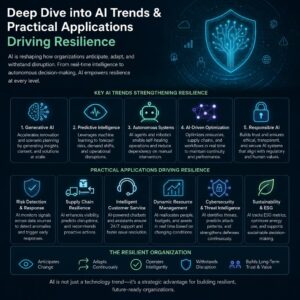
The landscape of AI is continually expanding, with new breakthroughs emerging at an astonishing pace. For businesses aiming to build resilience, understanding these key trends and their practical applications is crucial.
Generative AI: Fueling Creativity and Efficiency at Scale
Perhaps one of the most exciting and rapidly evolving areas is Generative AI. Technologies like Large Language Models (LLMs) are moving beyond simple data processing to create entirely new content, designs, and code.
- Content Creation: From drafting marketing copy and social media posts to generating internal reports and customer service responses, Generative AI tools can produce high-quality text in moments, dramatically accelerating content pipelines. Imagine an e-commerce business generating thousands of unique product descriptions tailored to different audiences, or a marketing team brainstorming campaigns with AI in real-time. This frees up human creatives to focus on high-level strategy and nuanced messaging, while AI handles the volume.
- Code Generation and Development: Developers are leveraging AI to write code, debug, and even generate entire software components, speeding up development cycles and reducing time-to-market for new products and services. This significantly boosts productivity for tech teams.
- Personalized Experiences: Generative AI can craft highly personalized customer communications, product recommendations, and user interfaces, leading to deeper engagement and loyalty. A financial institution could use AI to draft personalized financial advice based on a client’s portfolio and risk tolerance, enhancing perceived value and trust.
- Virtual Assistants and Chatbots: Beyond rule-based responses, advanced Generative AI-powered virtual assistants can understand complex queries, engage in natural language conversations, and provide nuanced support, vastly improving customer service efficiency and satisfaction. They can answer intricate questions, troubleshoot problems, and even handle sentiment analysis to de-escalate customer concerns, making them invaluable for maintaining robust customer support around the clock.
The ability of Generative AI to produce novel and contextually relevant outputs across diverse domains is a game-changer for operational efficiency and innovative output, directly contributing to a business’s capacity to adapt and grow.
Hyperautomation and Intelligent Workflow Optimization
Hyperautomation is the logical next step beyond traditional robotic process automation (RPA). It involves leveraging a combination of AI, machine learning (ML), RPA, business process management (BPM), and other advanced technologies to automate as many business and IT processes as possible.
- End-to-End Process Automation: Instead of automating isolated tasks, hyperautomation focuses on entire workflows. For example, in an HR department, AI can automate everything from candidate sourcing and initial screening to interview scheduling, onboarding paperwork, and payroll integration. This holistic approach eliminates bottlenecks and handoffs, creating seamless, efficient operations.
- Intelligent Document Processing (IDP): AI-powered IDP can extract, classify, and validate data from unstructured documents like invoices, contracts, and customer forms, regardless of format. This revolutionizes data entry, compliance, and record-keeping processes, drastically reducing manual effort and errors. A legal firm could use IDP to quickly process thousands of legal documents, extracting key clauses and dates, freeing up paralegals for more complex analysis.
- Workflow Orchestration: Platforms like n8n, combined with AI, allow businesses to create complex, multi-step automated workflows that integrate various applications and services. This means data can flow effortlessly between CRM, ERP, marketing platforms, and internal tools, ensuring data consistency and real-time insights without manual intervention. This level of integration is crucial for maintaining agility and data integrity across an organization.
- Proactive Problem Solving: By continuously monitoring processes and data, AI can identify potential issues or inefficiencies *before* they become critical problems. For instance, in manufacturing, AI can predict equipment failures, scheduling maintenance proactively and preventing costly downtime.
Hyperautomation doesn’t just make processes faster; it makes them smarter, more adaptable, and inherently more resilient to internal and external disruptions.
Predictive Analytics and Data-Driven Decision-Making
AI’s prowess in analyzing vast datasets allows businesses to move beyond reactive responses to proactive strategies. Predictive analytics uses ML algorithms to forecast future outcomes based on historical data.
- Market Trend Prediction: AI can analyze market data, news, and social media sentiment to predict emerging trends, allowing businesses to adjust product development, marketing strategies, and inventory levels in advance. This foresight is invaluable in maintaining a competitive edge.
- Customer Behavior Forecasting: By understanding past purchasing patterns, browsing history, and demographic data, AI can predict future customer needs, enabling personalized marketing campaigns and proactive customer service interventions. An e-commerce platform can predict which products a customer is likely to purchase next, leading to highly effective targeted promotions.
- Risk Management: AI models can identify potential financial risks, operational bottlenecks, or security threats by analyzing transaction data, network logs, and external indicators. This enables businesses to implement mitigating strategies before risks materialize, safeguarding assets and ensuring compliance. A cybersecurity firm could use AI to detect anomalous network behavior indicative of a breach, providing real-time alerts and automated responses.
- Optimized Resource Allocation: AI can predict demand for products or services, allowing businesses to optimize staffing levels, inventory management, and supply chain logistics, minimizing waste and maximizing efficiency.
The ability to anticipate the future with greater accuracy empowers businesses to make truly data-driven decisions, transforming uncertainty into strategic advantage and building formidable resilience.
Personalization at Scale: Elevating Customer Experience
In a competitive market, customer experience is a key differentiator. AI enables businesses to deliver highly personalized interactions and services at scale.
- Tailored Product Recommendations: AI analyzes user preferences and behavior to suggest products or content that are most relevant to each individual, enhancing the shopping or browsing experience.
- Dynamic Pricing: AI can adjust pricing in real-time based on demand, competitor prices, and customer segments, optimizing revenue while remaining competitive.
- Personalized Marketing Campaigns: AI crafts individualized marketing messages and offers, delivered through the most effective channels, significantly increasing engagement and conversion rates.
- Proactive Customer Support: AI can identify customers at risk of churning or those who might need assistance, allowing businesses to reach out proactively with solutions, strengthening loyalty.
By using AI to understand and cater to individual customer needs, businesses can foster deeper relationships, improve satisfaction, and build a loyal customer base, which is a crucial component of long-term resilience.
Ethical AI and Responsible Deployment: Building Trust
As AI becomes more integrated into business operations, the ethical considerations and the need for responsible deployment grow in importance. Issues like data privacy, algorithmic bias, transparency, and accountability are not just regulatory concerns but fundamental aspects of building trust with customers, employees, and stakeholders.
- Bias Detection and Mitigation: AI can be used to identify and mitigate biases in datasets and algorithms, ensuring fair and equitable outcomes, especially in areas like hiring, lending, and content moderation.
- Transparency and Explainability: Developing “explainable AI” (XAI) allows businesses to understand *how* AI models arrive at their conclusions, fostering transparency and trust. This is vital for compliance and for addressing concerns about AI’s decision-making processes.
- Data Governance and Privacy: Implementing robust AI requires stringent data governance policies, ensuring compliance with regulations like GDPR and CCPA, and protecting sensitive information.
- Human Oversight and Accountability: While AI automates, human oversight remains critical. Businesses must establish clear lines of accountability for AI systems and ensure there are mechanisms for human intervention and review.
Embracing ethical AI practices not only builds trust but also contributes to long-term brand reputation and regulatory compliance, solidifying a business’s resilience in the face of evolving societal expectations.
Practical Takeaways for Your Business
For leaders looking to integrate AI Automation for Business Resilience into their organizations, here are actionable steps:
- Identify High-Impact Automation Opportunities: Start by listing repetitive, manual, and rule-based tasks across all departments. Prioritize those that consume significant time, are prone to human error, or directly impact critical business functions. Think about areas like data entry, invoice processing, customer service FAQs, or report generation.
- Start Small, Think Big: Begin with a pilot project in a specific department or process. This allows your team to learn, iterate, and demonstrate tangible ROI quickly. Once successful, you can scale the solution and expand to other areas.
- Invest in AI Literacy and Training: AI is a tool, and its effectiveness depends on the people using it. Provide training for your employees on AI tools and concepts. Empower them to become “citizen developers” who can identify automation opportunities and even build simple workflows themselves.
- Focus on Data Quality and Governance: AI is only as good as the data it’s fed. Prioritize cleaning, organizing, and securing your data. Establish clear data governance policies to ensure accuracy, privacy, and accessibility.
- Foster a Culture of Continuous Improvement: AI implementation is not a one-time project. Encourage a mindset of continuous exploration and optimization. Regularly review automated processes, gather feedback, and look for new ways to leverage AI.
- Seek Expert Guidance: AI implementation can be complex. Partnering with specialists can accelerate your journey, mitigate risks, and ensure you’re adopting the right solutions for your unique business needs.
AI TechScope’s Role: Empowering Your AI Automation for Business Resilience Journey
At AITechScope, we understand that leveraging cutting-edge AI for business resilience is a journey, not a destination. Our mission is to empower businesses like yours to navigate the complexities of AI adoption, streamline operations, and achieve unparalleled efficiency through intelligent delegation and automation solutions.
We specialize in transforming business processes by integrating advanced AI tools and robust automation frameworks. Our expertise ensures that you not only adopt the latest technologies but also realize their full potential to scale operations, reduce costs, and significantly improve efficiency—critical components of AI Automation for Business Resilience.
Here’s how AITechScope can be your strategic partner:
- AI Automation & Consulting Services: We provide comprehensive AI consulting, guiding you from strategy development to implementation. Whether you’re exploring Generative AI for content creation, hyperautomation for workflow optimization, or predictive analytics for strategic foresight, our experts help you identify the most impactful applications for your business. We tailor solutions that integrate seamlessly into your existing ecosystem, ensuring a smooth transition and measurable ROI.
- n8n Workflow Development & Business Process Optimization: Our specialists excel in developing bespoke n8n workflows that connect your disparate applications and automate complex, multi-step processes. From integrating your CRM with marketing platforms to automating customer onboarding and data synchronization, n8n allows for flexible, powerful, and scalable automation. This significantly boosts operational efficiency, reduces manual effort, and ensures data consistency across your organization, laying a strong foundation for digital transformation.
- Intelligent Virtual Assistant Services: We empower your teams with AI-powered virtual assistants that intelligently handle a wide range of tasks, from administrative support and customer service inquiries to data analysis and report generation. This intelligent delegation frees up your human talent to focus on high-value, strategic work, enhancing overall productivity and job satisfaction. Our virtual assistants are designed to learn and adapt, becoming increasingly proficient over time, ensuring your operations are always running at peak performance.
- Website Development for AI Integration: Your website is often the first point of contact for customers and a critical operational hub. We develop modern, scalable websites that are engineered to seamlessly integrate with AI tools. Whether it’s embedding AI-powered chatbots for instant customer support, dynamic content personalization engines, or analytics dashboards, we ensure your digital storefront is not just visually appealing but also a smart, efficient, and AI-enabled powerhouse.
By partnering with AITechScope, you’re not just investing in technology; you’re investing in a more agile, efficient, and resilient future for your business. We connect AI developments directly to tangible benefits in business efficiency, digital transformation, and workflow optimization, ensuring that your investment yields maximum returns.
Navigating the Future with AI
The economic currents will continue to shift, and the landscape of business will remain dynamic. What distinguishes truly resilient organizations is their proactive embrace of change and their strategic adoption of technologies that fortify their foundations. AI Automation for Business Resilience is more than a trend; it’s a strategic imperative that equips businesses with the tools to not only survive but thrive in any economic climate. By automating intelligently, leveraging data for foresight, and fostering a culture of innovation, businesses can build an enduring competitive advantage.
The future belongs to those who are prepared, and preparation in the digital age means harnessing the immense power of artificial intelligence. It means transforming operational challenges into opportunities for growth, and ensuring that your business is not just adaptable, but truly resilient.
Ready to Build Your Resilient, AI-Powered Future?
Don’t let economic uncertainties dictate your business’s trajectory. Partner with AITechScope to unlock the full potential of AI automation for your organization. Whether you need strategic AI consulting, robust n8n workflow development, intelligent virtual assistant services, or AI-integrated website solutions, we have the expertise to transform your operations and build unparalleled resilience.
Frequently Asked Questions (FAQ)
What is AI Automation for Business Resilience?
AI Automation for Business Resilience refers to the strategic implementation of artificial intelligence technologies to automate tasks, optimize processes, enhance decision-making, and manage risks, thereby enabling businesses to maintain operational stability and adapt quickly to economic shifts and unforeseen challenges.
How does AI automation reduce costs for businesses?
AI automation reduces costs by automating repetitive and rule-based tasks such as data entry, customer service inquiries, and report generation, which significantly lowers labor costs and minimizes human errors. This leads to more efficient resource allocation and reduced operational expenses.
What are some practical applications of Generative AI in business?
Generative AI can be applied in various ways, including content creation (marketing copy, social media posts, reports), code generation and debugging, crafting personalized customer experiences (recommendations, communications), and powering advanced virtual assistants and chatbots for nuanced customer support.
Why is ethical AI important for business resilience?
Ethical AI practices, including bias detection, transparency, robust data governance, and human oversight, are crucial for building trust with customers, employees, and stakeholders. Adhering to ethical principles ensures compliance with regulations, protects brand reputation, and fosters long-term sustainability, all of which contribute to overall business resilience.
What steps should a business take to start with AI automation?
Businesses should start by identifying high-impact automation opportunities, beginning with small pilot projects to test and iterate. It’s also vital to invest in AI literacy and training for employees, prioritize data quality and governance, foster a culture of continuous improvement, and consider seeking expert guidance from specialists like AITechScope.